
Hebei jiali Rigging Manufacturing Co., Ltd.
English

Views: 0 Author: Site Editor Publish Time: 2026-10-03 Origin: Site


Standard lifting equipment often fails under the stress of continuous, high-frequency cycles. This leads to motor burnout and expensive production downtime. Facility managers and engineers frequently underspecify lifting equipment. They focus solely on load capacity while ignoring duty cycle, starts-per-hour, and thermal dissipation requirements. This oversight results in premature equipment failure, safety hazards, and severe operational bottlenecks on the facility floor.
Selecting the right Electric Hoist engineered specifically for repetitive, heavy-duty industrial applications requires a comprehensive technical evaluation. You must look beyond basic weight limits. Analyze how the equipment handles heat, mechanical stress, and continuous electrical loads. This guide provides a rigorous technical framework for specifying hoists that balance upfront procurement with long-term reliability. We will help you ensure your operations remain safe, efficient, and uninterrupted.
Duty Cycle is Non-Negotiable: Load capacity is only half the equation; HMI/ASME duty cycle ratings (e.g., H4 or H5) dictate whether a hoist will survive frequent lifting cycles.
Thermal Management Prevents Failure: High-frequency operations require specific motor cooling mechanisms, such as finned aluminum housings and active thermal overload protection.
VFDs Extend Equipment Life: Variable Frequency Drives (VFDs) reduce mechanical shock, minimize brake wear, and offer precise load control during repetitive tasks.
Long-Term Value Outweighs Initial Price: Investing in an appropriately rated industrial electric hoist reduces long-term maintenance costs and prevents production bottlenecks.
In industrial environments, lifting frequency is measured by two primary metrics: maximum runtime per hour and maximum starts per hour. A standard duty hoist might be rated for 15 to 20 minutes of runtime per hour with a maximum of 150 starts. In contrast, a high-frequency application often demands 30 to 60 minutes of continuous runtime and upwards of 300 starts per hour. Understanding these metrics is the foundation of proper equipment selection.
A "start" is recorded every single time the motor is energized. Operators frequently use micro-movements, commonly known as "jogging" or "plugging," to precisely position a load. If an operator presses the pendant button five times in rapid succession to align a heavy component, the hoist registers five distinct starts. Each start draws a massive surge of inrush current. This rapid succession of inrush currents generates extreme heat within the motor windings. If the equipment lacks the thermal capacity to dissipate this heat, the internal temperature quickly exceeds safe operating limits.
Operational Metric | Standard Duty Application | High-Frequency Application |
|---|---|---|
Max Runtime Per Hour | 15 - 20 minutes | 30 - 60+ minutes |
Max Starts Per Hour | Up to 150 starts | 300 to 600+ starts |
Typical Use Case | Light assembly, maintenance | Automated cells, stamping plants |
Cooling Requirement | Ambient air cooling | Active fans, finned housings |
Deploying a standard-duty hoist in a high-frequency application triggers a rapid cascade of mechanical and electrical failures. The first component to suffer is usually the braking system. Standard AC spring-set brakes rely on friction materials that glaze over or disintegrate when subjected to continuous engagement and disengagement without adequate cooling time. Once the brake friction material degrades, load drift becomes a serious safety hazard.
Electrically, underspecified hoists suffer from contactor failure and motor winding degradation. The constant arcing caused by rapid jogging pits the electrical contactors, eventually causing them to weld shut. When contactors weld, the hoist can continue moving even after the operator releases the button, creating a highly dangerous situation. Furthermore, the persistent heat from excessive starts breaks down the insulation on the motor windings. Motor windings are coated in a thin layer of insulating varnish. If the heat exceeds the thermal rating of the varnish, it melts. Once the bare copper wires touch, you get a dead short. The motor blows, leaving you with a heavy piece of scrap metal hanging from your bridge crane.
The Hoist Manufacturers Institute (HMI) and the American Society of Mechanical Engineers (ASME) provide standardized classifications to help engineers match lifting equipment to application demands. Understanding these classifications prevents catastrophic underspecification.
H3 (Standard Duty): Designed for general machine shop fabricating, assembly, and maintenance. Suitable for 15-20 minutes of runtime per hour and up to 150 starts per hour.
H4 (Heavy Duty): Engineered for high-volume handling in steel warehouses, foundries, and heavy manufacturing. Rated for 30 minutes of runtime per hour and up to 300 starts per hour.
H5 (Severe Duty): Built for continuous, automated operations, such as bulk material handling. Rated for 60 minutes of runtime per hour and 600 or more starts per hour.
Alongside HMI ratings, European manufacturers often use the ED (Einschaltdauer) rating, expressed as a percentage. An ED rating of 40% means the motor can run for 4 minutes out of every 10-minute cycle without overheating. High-frequency applications typically require an ED rating of 40% to 60%, ensuring the motor has sufficient thermal mass to handle continuous cycles.
To calculate your required ED rating, follow these steps:
Measure the exact time the motor is running during one complete lifting and lowering cycle.
Measure the total time of the cycle, including the resting period where the motor is off.
Divide the run time by the total cycle time.
Multiply the result by 100 to get your ED percentage.
Selecting the correct lifting speed is a delicate balance between meeting production quotas and maintaining safe load control. Single-speed motors are common in basic applications, but they force operators to jog the controls to achieve precision, driving up the starts-per-hour count. Two-speed motors offer a distinct advantage by providing a fast speed for bulk movement and a slow speed for precise positioning, significantly reducing the need for jogging.
For the ultimate in precision and equipment longevity, integrating a Variable Frequency Drive (VFD) is highly recommended. A VFD changes the frequency of the electrical power supplied to the motor. Instead of slamming the motor with 60Hz instantly, it ramps up from 0 to 60Hz over a programmed interval. This eliminates the violent jerk on the load chain. By smoothly ramping up the speed, VFDs prevent load sway, protect gear teeth from impact stress, and drastically extend the lifespan of the lifting medium.
The electrical infrastructure of your facility dictates the type of hoist you can safely deploy. A 110V single-phase outlet is convenient, but it lacks the voltage to push heavy amperage efficiently. Single-phase motors lack the starting torque and thermal efficiency required for continuous industrial cycles. High-frequency operations demand three-phase power.
Three-phase power provides three alternating currents that peak at different times. This delivers continuous, smooth power to the motor, generating significantly more starting torque and running much cooler. However, voltage stability is critical. Continuous cycling in a facility with a fluctuating power supply can cause voltage drops. When voltage drops, the motor draws higher amperage to maintain torque, generating excessive heat. You must ensure your electrical drops are sized correctly with heavy-gauge wire to prevent voltage sag at the hoist terminal.
Manual chain hoists rely entirely on human effort. While they are cost-effective and highly portable, they are completely unsuitable for high-frequency tasks due to extremely slow lifting speeds and high operator fatigue. Transitioning to powered lifting is mandatory for repetitive cycles.
When comparing powered options, electric hoists are the standard for modern manufacturing. They offer plug-and-play installation, exceptional energy efficiency, and advanced programmable controls. Pneumatic (air) hoists serve as a specialized alternative. Air hoists are inherently self-cooling because the expanding exhaust air absorbs heat, giving them a true 100% duty cycle. They are also spark-resistant, making them ideal for highly explosive environments. However, pneumatic systems require massive, energy-intensive air compressors, extensive airline infrastructure, and constant inline lubrication, making electric models far more practical for standard manufacturing environments.
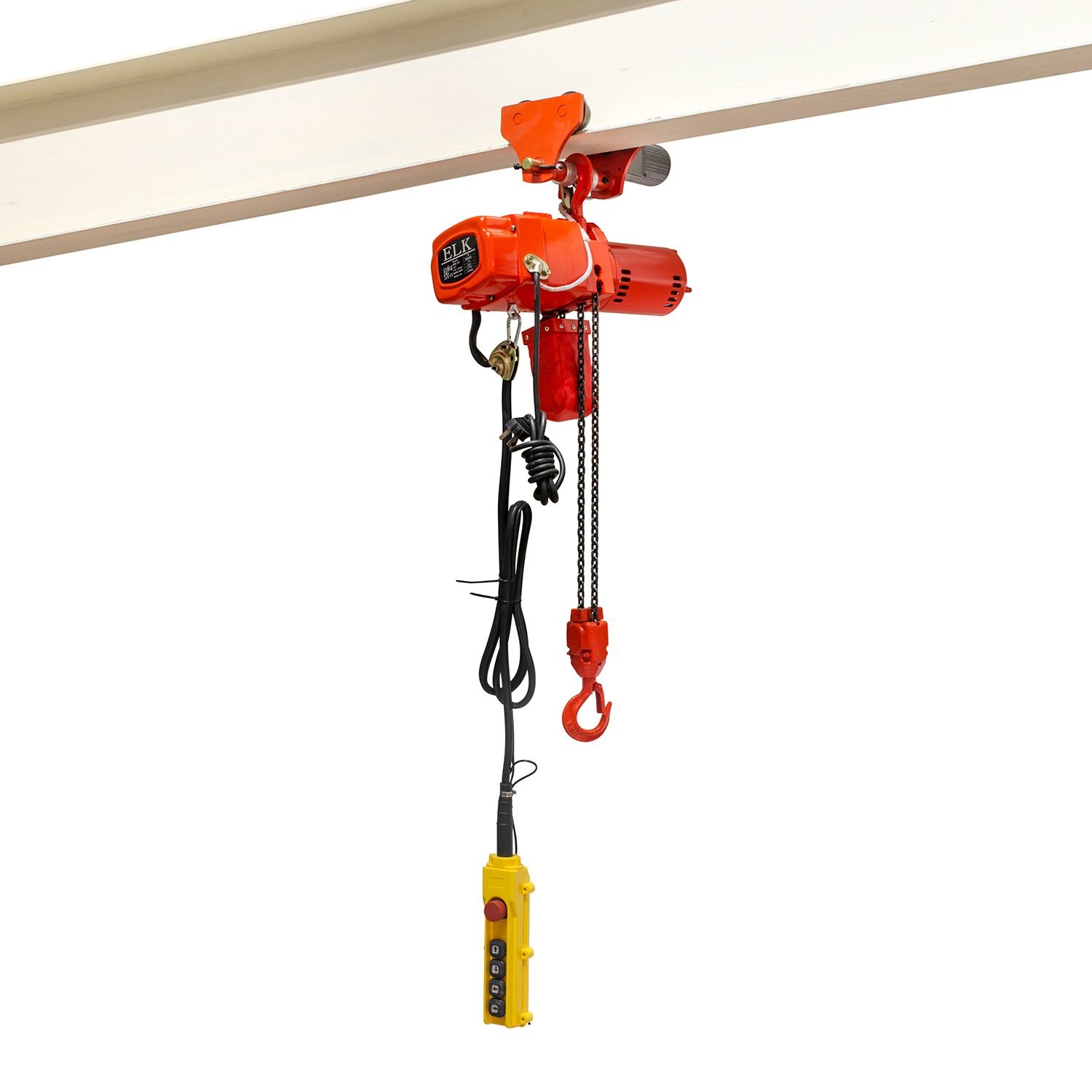
For repetitive assembly operations, machining centers, and general manufacturing cells, the industrial chain hoist is the undisputed workhorse. These units lift via a hardened steel sprocket that pulls a calibrated load chain. This design provides a true vertical lift without the lateral drift associated with wire rope drums.
The load capacity sweet spot for these units typically ranges from 1 to 5 tons. They are highly durable in harsh environments, resisting dust, debris, and minor impacts far better than wire rope alternatives. However, continuous use demands strict maintenance protocols. You cannot run a chain dry. The links hinge against each other under extreme pressure. A dry chain will wear at the bearing points, elongating the chain. Once it elongates, it won't seat properly in the lift wheel pockets. It will start popping and grinding. You must use a high-quality penetrating oil that gets inside the link contact points.
Wire rope models are positioned for ultra-heavy capacities, typically starting at 5 tons and scaling well beyond 50 tons. They utilize a grooved drum to spool a steel cable. Wire rope units offer significantly faster lifting speeds and exceptionally smooth, quiet operation compared to chain models.
A wire rope hoist uses a grooved drum. As the cable pulls the load, it wraps neatly into these grooves. If the operator pulls the load at an angle, the cable will jump the groove. It will wrap over itself, crushing the steel strands and creating a severe weak point. Wire rope units have a much larger footprint and require significant headroom. They are best suited for large overhead bridge cranes rather than localized, high-cycle workstation jibs.
A mini electric hoist is designed for portability, light assembly, and intermittent maintenance tasks. These compact units operate on standard 110V/220V single-phase power and are incredibly useful for DIY workshops or occasional lifting in commercial garages.
However, you must explicitly understand why these units fail in high-frequency, continuous-duty industrial environments. They lack the physical thermal mass required to absorb and dissipate heat. Their duty ratings are typically H2 or lower, meaning they require long cooldown periods after just a few minutes of use. Subjecting a mini model to continuous industrial cycling will quickly melt the internal wiring, burn out the capacitor, and destroy the lightweight gear train. They should never be specified for production line environments.
The braking mechanism is the most highly stressed component in a high-cycle application. Standard AC spring-set brakes use a spring to push a friction pad against a plate. When you pull the trigger, a coil magnetizes and pulls the pad back. In high-cycle use, that coil gets hot. The friction pad glazes over rapidly. DC electromagnetic brakes are far superior for frequent cycling. A built-in rectifier converts the AC supply to DC power specifically for the brake coil. They snap back faster, run cooler, and provide a more positive hold on the load.
For the highest frequency applications, regenerative braking via a VFD is the optimal solution. Instead of relying solely on physical friction pads to slow the load, the VFD uses the motor itself as a generator, absorbing the kinetic energy of the descending load and dissipating it through braking resistors. The mechanical holding brake only engages once the motor has brought the load to a complete stop. This drastically reduces physical wear on the brake friction discs, extending their lifespan from months to years.
Heat is the enemy of electrical equipment. High-frequency hoists must be physically designed to shed heat rapidly. Look for motors enclosed in deeply finned aluminum housings. Aluminum transfers heat much faster than cast iron, and the fins exponentially increase the surface area available for cooling. Many heavy-duty models also incorporate internal cooling fans attached directly to the motor shaft, forcing air over the fins whenever the motor is running.
Active thermal protection is also mandatory. High-quality units feature bi-metallic thermal overload relays or PTC thermistors embedded directly into the motor windings. If the internal temperature approaches the failure point of the insulation, these sensors automatically interrupt the control circuit, preventing the operator from lifting until the motor cools down to a safe temperature. This simple component prevents thousands of dollars in motor replacement costs.
The gear train transmits the high-speed rotation of the motor into the low-speed, high-torque force needed to lift heavy loads. Standard-duty hoists often use grease-lubricated gearboxes. When gears mesh, they create friction and heat. In a grease-lubricated system, the grease is pushed out of the gear teeth path after a few rotations. It relies on the ambient temperature to cool down.
High-frequency applications require oil-bath gearboxes. In an oil-bath system, the gears are fully submerged in synthetic gear oil. The oil flows over the teeth, absorbing the heat, and then circulates to the outer aluminum casing where the cooling fan blows ambient air over the fins. This continuous thermal transfer loop is what allows an H4 hoist to run for 30 minutes an hour without destroying the metallurgy of the gear teeth.
Evaluating lifting equipment solely on the initial purchase price is a critical engineering error. A comprehensive framework for calculating long-term value must include the initial purchase price, installation labor, projected maintenance over a ten-year lifespan, and energy consumption.
Demonstrating long-term value often involves over-specifying the equipment. For example, deploying an H4-rated industrial electric hoist in an application that technically only requires an H3 rating provides a massive buffer against thermal overload. The heavier-duty components will experience significantly less strain, resulting in fewer brake adjustments, longer contactor life, and virtually zero heat-related downtime. The reduction in unexpected maintenance and lost production hours quickly offsets the higher initial procurement cost.
Operator fatigue directly impacts production speed and safety. The control interface plays a major role in this dynamic. Standard pendant controls hang from the hoist, forcing the operator to walk closely alongside the suspended load. While reliable, pendants can become tangled in machinery and limit operator mobility.
Radio remote controls are highly recommended for high-tempo environments. They allow the operator to stand at a safe distance, improving visibility and protecting them from swinging loads or hazardous materials. Additionally, the physical footprint of the hoist impacts workstation ergonomics. Compact, low-profile designs maximize the available lifting height, allowing operators to maneuver large components over obstacles without straining.
Before specifying a hoist, you must analyze the structural constraints of the facility. Mounting options dictate how the equipment interacts with the overhead runway beam. Hook mounts and lug mounts are stationary, ideal for fixed-point lifting. For lateral movement, trolleys are required.
Push trolleys require the operator to physically push the suspended load along the beam. If you have a 2-ton load moving every five minutes, a push trolley will exhaust the operator and cause the load to swing wildly. Motorized trolleys are mandatory for heavy, repetitive lateral movements. A motorized trolley uses a separate electric motor to drive the wheels along the beam flange. When paired with a VFD, the motorized trolley accelerates smoothly, keeping the load perfectly plumb during travel.
The operating environment dictates the required physical protection of the equipment. IP stands for Ingress Protection. An IP55 rating means the unit is protected against dust that could interfere with normal operation, and it can withstand low-pressure water jets. This is standard for most indoor manufacturing. However, if you are operating in a foundry with fine metallic dust, or a food processing plant that uses high-pressure chemical washdowns, IP55 will fail. You need IP65 or IP66 units featuring double-sealed gaskets and potted electronics.
Explosion-proof environments are classified by Class, Division, and Group. You cannot put a standard hoist in a room with flammable gases. Every time a contactor closes, it creates a small electrical arc that will ignite the room. EX-rated hoists enclose all electrical components in heavy cast-iron or machined aluminum housings designed to contain an internal explosion. They also utilize spark-resistant components, such as solid bronze hooks and stainless steel load chains, to prevent mechanical sparks.
Proper commissioning is the final step in ensuring long-term reliability. Upon installation, the equipment must undergo rigorous load testing, typically at 125% of its rated capacity, to verify structural integrity and brake performance. This testing must comply with strict OSHA regulations and ASME B30.16 standards.
Establishing a preventative maintenance schedule tailored specifically to high-cycle usage is critical. Standard annual inspections are insufficient for continuous-duty applications. You must implement a rigorous audit schedule:
Daily: Check pendant buttons for sticking. Listen for abnormal brake chatter. Verify upper limit switch operation without a load.
Weekly: Inspect load chain for lack of lubrication. Check hook latches for deformation.
Monthly: Measure chain wear with a gauge. Inspect contactors for pitting. Drain and check a small sample of gearbox oil for metal shavings.
When specifying lifting equipment for frequent cycles, the duty cycle and thermal management capabilities must dictate the purchasing decision over baseline load capacity. Ignoring these technical realities guarantees premature failure and operational disruption. The ideal specification for a high-frequency manufacturing environment is a three-phase industrial chain hoist, rated H4 or above, equipped with active thermal protection, an oil-bath gearbox, and a Variable Frequency Drive for precise, shock-free load control.
To ensure you select the correct equipment, take the following actions:
Audit your current operational metrics to determine the exact maximum starts-per-hour and continuous runtime required by your production line.
Consult with a structural engineer to verify that your existing runway beams or jib cranes can support the dynamic forces of heavier, continuous-duty equipment.
Request detailed duty-cycle specifications, ED ratings, and thermal management data from manufacturers before finalizing any procurement decisions.
Implement a strict, high-frequency preventative maintenance schedule focusing on chain lubrication and brake inspection immediately upon installation.
A: Duty cycle defines the maximum allowable continuous runtime and the maximum number of starts-per-hour a motor can handle before overheating. It is typically measured using HMI/ASME classes (like H3, H4, or H5) or as an ED percentage, dictating the equipment's safe operational limits.
A: Every time the control button is pressed, it counts as a start. This includes all micro-adjustments or "jogging" used to position a load. To calculate the total, count the number of button presses required for one complete lifting task, and multiply that by the total number of tasks performed per hour.
A: No. Mini models are designed strictly for intermittent, light-duty tasks, typically rated at H2 or lower. They lack the necessary thermal mass, cooling fins, and heavy-duty contactors required to dissipate the extreme heat generated by continuous, high-frequency industrial operation.
A: Chain models lift via a steel sprocket pulling a calibrated chain, making them ideal for true vertical lifts and highly durable in harsh environments. Wire rope models spool a steel cable onto a grooved drum, making them better suited for ultra-heavy loads, faster lifting speeds, and smoother operation.
A: Electric models are generally more energy-efficient, offer precise programmable control, and are much easier to install. Pneumatic models are preferred only when a 100% continuous duty cycle is required without overheating, or in highly explosive environments where absolute spark resistance is mandatory.
A: No. Manual models rely entirely on physical human effort and operate at very slow speeds. Using them for repetitive, high-frequency lifting causes severe operator fatigue, drastically reduces production efficiency, and increases the risk of ergonomic workplace injuries.


