loading


| Availability: | |
|---|---|
| Quantity: | |


◆◆ Product Advantage
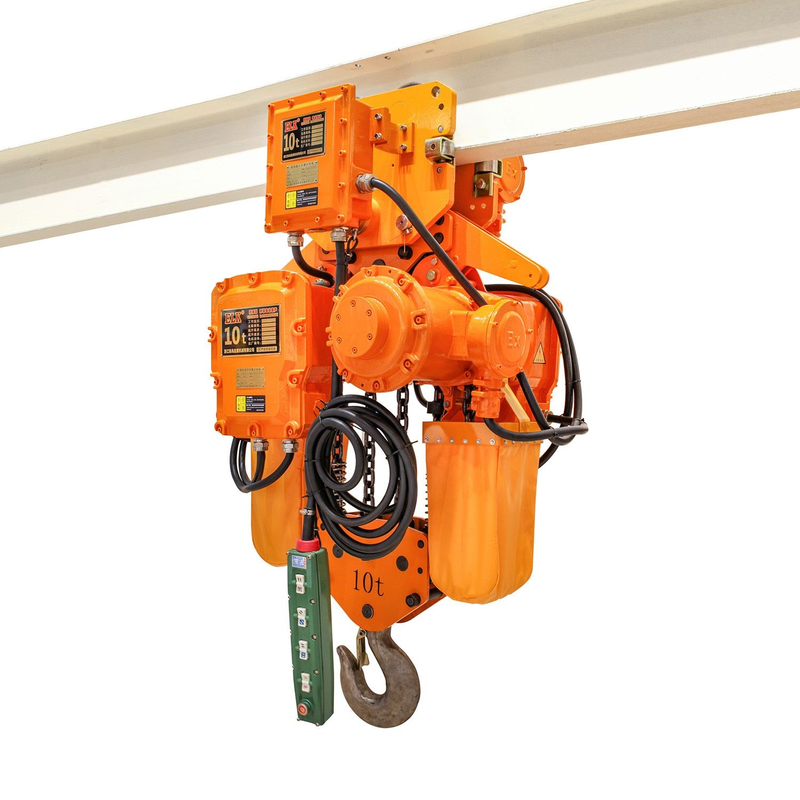
High-Efficiency Drive System with Industrial-Grade Reliability
Powered by a high-torque permanent magnet synchronous motor (PMSM), our electric hoist delivers 30% higher lifting efficiency than conventional AC motors, reducing energy consumption by up to 25% in long-term operations. Paired with a variable frequency speed regulation system, it supports smooth speed adjustment from 0.1m/min (micro-speed gear for precision tasks) to 12m/min (high-speed mode for bulk handling), ensuring stable performance even under 10-ton rated loads. This industrial-grade setup minimizes downtime, making it ideal for 24/7 manufacturing lines.
Intelligent Safety & Control with Data-Driven Protection
Equipped with a multi-sensor safety module, the hoist monitors load weight (accuracy ±2%), temperature (overheat alert at 85℃), and wire rope tension in real time. Its anti-sway control system limits load swing to <50mm during operation, while dual brake systems (electromagnetic + mechanical) ensure zero drift after power failure. Remote control supports 3 modes (handheld pendant, mobile app, fixed console) with a transmission distance ≥100m, enhancing operator safety in high-risk zones.
Low-Noise Design for Environment-Friendly Operations
Adopting helical gear reduction and noise-dampening mounting brackets, the hoist operates at ≤65dB (A) under full load—15dB lower than industry averages—compliant with ISO 3744 noise standards. This makes it suitable for precision workshops, hospitals, and food processing facilities requiring quiet environments. Additionally, modular components allow quick maintenance (average repair time <30 minutes), reducing operational disruptions.
Customizable Configurations for Diverse Scenarios
We offer 4 standard models (500kg-10t) with optional features: explosion-proof design (Ex d IIB T4 Gb) for chemical plants, corrosion-resistant coating (salt mist test >1000h) for coastal warehouses, and smart IoT integration (real-time data upload via 4G) for Industry 4.0 facilities. Each configuration undergoes 500-hour fatigue testing, ensuring durability across 10+ years of heavy use.
◆◆ Technical Parameters
| Lifting Capacity | 0.5t - 50t (Common: 1t/2t/5t/10t) |
| Lifting Height | 3m - 30m (customizable up to 100m) |
| Lifting Speed | Single-speed: 3.5 - 8m/min Double-speed: 0.35 - 8m/min (variable frequency adjustable) |
| Motor Type | Permanent Magnet Synchronous Motor (PMSM) / Conical Rotor Motor |
| Motor Power | Lifting Motor: 0.4 - 13kW Running Motor: 0.2 - 2.2kW |
| Insulation Class | Class H (temperature resistance up to 180℃) |
| Working Level | M3 - M8 (M6 for metallurgical standards) |
| Load Limit Protection | Accuracy ±2% |
| Brake System | Dual brake (electromagnetic + mechanical) Wire Rope: 6×19+NF (1770MPa) to 8×37+NF (1870MPa) |
| Wire Rope Specification | 10-year maintenance-free (gear material: 20CrMnTi) |
| Protection Class | IP55 (dust and water-resistant) |
| Operating Temperature | -25℃ ~ +40℃ (high-temperature version up to +80℃) |
| Energy Efficiency Class | IE3 (super-efficient) |
| Noise Level | ≤65dB(A) (low-noise version ≤55dB(A)) |
| Explosion-Proof | Ex d IIB T4 Gb (dust environment: Ex tD A21 IP66) |
| Corrosion Resistance | Salt spray test >1000h |
| IoT Integration | Real-time data upload (4G/Wi-Fi) |
| Remote Control | ≥100m (supports handheld terminals, mobile apps) |
◆◆ Product Uses
1. Material Handling on Industrial Production Lines
In automotive manufacturing, machinery processing, and other scenarios, electric hoists are used for lifting heavy objects such as engines and metal castings (5t-20t), enabling 24-hour continuous operation in coordination with automated production lines. Their variable frequency speed regulation function (0.1-12m/min) ensures precise alignment with robotic arm positioning, reducing human intervention errors. For example, an automobile factory improved assembly line material turnover efficiency by 40% after adopting dual-speed chain electric hoists.
2. Efficient Stacking in Logistics Warehouses
Suitable for loading/unloading palletized goods on high-rise racks (10m+), electric hoists achieve ±5mm positioning accuracy via wireless remote control. After deploying 5t MD-type hoists in an e-commerce warehouse, daily throughput increased from 8,000 to 12,000 units, with labor costs reduced by 35%. The modular track design supports rapid deployment, shortening renovation cycles to 3 days.
3. Heavy Lifting in Construction Projects
Used for hoisting steel beams (3t-8t per beam), precast concrete slabs, etc., in high-rise buildings, electric hoists with anti-sway control systems limit load deviation to within 30mm. A landmark project utilized explosion-proof hoists (Ex d IIB T4) for steel structure plant construction, achieving 1,000 hours of fault-free operation and safety compliance with EN 13158 certification.
4. Cleanroom and Special Environment Operations
Fully enclosed stainless steel models (e.g., 1t dust-free hoists) meet ISO Class 5 cleanliness requirements, applied in semiconductor and pharmaceutical industries. With IP55 protection class and positive pressure air supply systems, they control dust particle concentration ≤10μm/m³, preventing contamination of sensitive production environments.
5. Port and Ship Equipment Maintenance
Corrosion-resistant models (salt spray test >2000h) are used for container lifting at ports and ship section alignment. After deploying 10t metallurgical-grade hoists at a port, equipment failure rates dropped by 70% during typhoon seasons, supporting stable operation across -25℃ to +50℃ extreme temperatures.
6. Power and Chemical Equipment Overhaul
Hoists integrated with IoT modules enable remote monitoring of bearing temperature (±1℃ accuracy) and wire rope tension (error <2%), providing early fault warnings. A power plant case study showed annual maintenance cost reductions of ¥280,000 and a 60% decrease in downtime.
◆◆ Product Operate Guide
Before Startup: Check that the power connection is normal, with no twists or wear on the wire rope/chain (reset if the overload alarm is triggered); confirm no obstacles in the operating area.
Startup: Press the "Power" button on the remote control. The instrument panel will light up, and the device enters standby mode (green indicator light).
Operation: To lift/lower, press the "↑/↓" buttons gently. Ensure the load does not exceed the rated capacity (the red warning light will turn on if overloaded). For horizontal movement, smoothly adjust via the track controller to avoid shaking from sudden stops.
Stop: Press the "Stop" button once the target position is reached. Wait for the load to come to a complete stop before cutting off power. For long-term non-use, disconnect the main power supply.
Tips: For first-time use, perform 3 no-load test runs to familiarize yourself with the operation feel. In emergencies, immediately press the "Emergency Stop" button (large red button) on the remote control.
(Note: Specific parameters shall be based on the equipment nameplate and instruction manual. Safety training is required before operation.)
◆◆ Product Video
◆◆ FAQ
Q1: How to prevent overloading accidents?
Our hoist is equipped with a precision load sensor (±2% accuracy) that triggers visual/audible alarms when exceeding 105% of rated capacity. Operators must check the load against the nameplate before lifting; red warning lights will flash if overloaded, and the motor will cut off automatically.
Q2: What’s the routine maintenance cycle?
Daily: Inspect/chain for wear, check brake responsiveness. Monthly: Lubricate gearbox (use specified grease) and tighten electrical connections. Annually: Professional inspection for insulation resistance (≥10MΩ) and load testing (1.25x rated load).
Q3: Why does the remote control have a short range?
Range is typically ≥100m in open areas. Reduced range may be caused by metal obstacles, strong electromagnetic interference, or low battery. Solutions: Avoid obstacles, use shielded cables, or upgrade to a long-range remote (optional, up to 300m with antenna extension).
Q4: Can the hoist work in rainy or humid environments?
Standard models are IP55-rated (dust-tight, water jet protection). For heavy rain (>100mm/h) or high humidity (>85%), use IP65 models with sealed enclosures and anti-corrosion coatings. Always check insulation resistance before use in damp conditions.
Q5: How long does the wire rope last?
Lifespan depends on load (≤80% rated capacity extends life), environment (dry vs. corrosive), and maintenance. Under normal conditions, it lasts 2-3 years; high-frequency use (e.g., 24/7 operation) may require replacement every 12-18 months. Regular inspections (monthly) are critical.

Buying an electric pallet truck? Uncover hidden lifecycle fees, compare lithium vs lead-acid batteries, and avoid costly procurement mistakes.

Eliminate warehouse bottlenecks and manual lifting fatigue. Discover how the right electric pallet truck boosts throughput, safety, and ROI.

Forklift or electric pallet truck? Eliminate bottlenecks by matching the right material handling equipment to your warehouse workflow and space.

Choosing between electric and manual chain hoists? Prevent costly specification errors by comparing duty cycles, costs, and safety in this guide.

Maximize warehouse throughput. Learn how to select the right electric pallet truck by evaluating load realities, duty cycles, and battery types.

Avoid liability & OSHA fines. Learn proper chain hoist inspection intervals: daily to annual, based on service class, per ASME B30.16. Stay safe.

Stop guessing chain hoist capacity. Use this method: add 25% safety margin, factor rigging weight, and match duty cycles for safe, efficient lifting.

Discover safe manual chain hoist setup steps, pre-lift tests, and compliance tips to prevent catastrophic load drops and ensure workplace safety.

Calculate lift height for manual chain hoists with our guide. Prevent dangerous tail chain hazards. Ensure OSHA-compliant rigging. Order correctly.

Stop risking safety with wrong chain hoist specs. Calculate true load, duty cycles, & ensure compliance. Expert guide.

Master electric pallet truck safety and operations. Learn essential SOPs, daily checks, and key features to prevent accidents and boost efficiency.

Maximize electric pallet truck battery life. Compare lead-acid vs. lithium-ion runtimes, lifespans, and maintenance to prevent costly downtime.

Reduce operator fatigue and boost warehouse efficiency with the right electric pallet truck. Learn to select models, battery types, and capacity.

Confused by electric pallet truck jargon? Learn to choose the right walkie, rider, or stacker to maximize warehouse efficiency and boost ROI.

Is a powered pallet truck legally a forklift? Yes. Learn OSHA classifications, mandatory training, and key differences to avoid costly fines.

Industrial lifting carries immense high-stakes realities. Choosing the wrong lifting equipment exposes operations to severe payload damage, strict regulatory penalties, and catastrophic safety failures.

Synthetic rigging drives modern material handling across construction, manufacturing, and logistics. Within this demanding field, the Type 3 flat eye-and-eye configuration stands out as the industry’s default workhorse. It balances immense lifting power and everyday practicality.

Selecting the right lifting sling goes far beyond merely checking a weight capacity chart. It represents a critical safety and operational efficiency decision shaping your entire Total Cost of Ownership (TCO).

Lifting massive industrial loads leaves zero room for error. Selecting the wrong lifting sling doesn't just risk operational downtime. It introduces catastrophic safety liabilities and inflates equipment replacement costs instantly.

While the "3-3-3 rule" recently trended across various fitness platforms, it holds a drastically different meaning in industrial material handling. In the high-stakes environment of industrial lifting, it represents a non-negotiable operational safety and rigging framework.


