
Views: 0 Author: Site Editor Publish Time: 2026-09-28 Origin: Site


High-frequency, repeated lifting tasks expose material handling equipment to extreme mechanical and thermal stress. This makes the selection of lifting equipment a major operational risk factor. Underspecifying lifting equipment for repetitive workshop tasks leads to premature motor burnout, brake failure, costly production downtime, and severe safety hazards. You cannot afford equipment failures during peak operational hours.
Selecting the correct Electric Hoist requires moving beyond basic weight capacity. You must evaluate duty cycles, power phases, and motor cooling mechanisms. Structural configurations and specific lifting media also play massive roles. A chain setup performs differently than a wire rope setup. You must tailor these choices to your facility's specific operational cadence. We will break down exactly how to match hoist specifications to rigorous workshop demands so you avoid costly downtime.
Duty Cycle is the Primary Metric: For repeated lifting, the hoist’s duty cycle (ASME H-ratings or FEM/ISO classification) and maximum starts per hour dictate viability more than maximum load capacity.
Power Supply Dictates Performance: True repetitive workshop lifting almost exclusively requires three-phase power to manage heat generation and electrical efficiency, leaving single-phase units for lighter, intermittent tasks.
Media Selection Impacts Longevity: An electric wire rope hoist excels in high-speed, high-capacity, and smooth-lifting scenarios, whereas chain hoists offer superior durability for true vertical, repetitive, mid-capacity lifts.
Thermal Management is Non-Negotiable: High-frequency operations require electric hoists equipped with advanced heat dissipation, thermal overload protection, and Variable Frequency Drives (VFD) or two-speed motors to prevent failure.
Infrastructure Dictates Selection: The choice between standard and low-headroom configurations, as well as suspension types (hook vs. motorized trolley), is strictly governed by the workshop’s existing structural limitations and gantry setups.
Duty cycle ratings determine how long a motor can run before it needs to cool down. You will typically see classifications from ASME, FEM, or ISO. ASME H3 indicates standard duty, allowing for about 30 minutes of operation per hour. ASME H4 designates heavy duty, suitable for high-volume handling in steel warehouses or machine shops where equipment runs up to 40 minutes per hour. ASME H5 covers severe duty for continuous automated operations. You must match your workflow to these ratings to prevent equipment destruction.
Manufacturers also use the ED% (Intermittent Duty Rating). This percentage represents the maximum active operating time within a specific cycle, usually 10 minutes. A 40% ED rating means the motor can run for 4 minutes out of every 10. The remaining 6 minutes must be rest. Exceeding this limit melts motor windings and destroys internal insulation.
You must also track "Starts per Hour." Every time an operator presses the pendant button, a massive surge of electricity hits the motor. This creates instant heat. High starts per hour degrade electrical components and wear out contactors rapidly. Heavy-duty units typically handle up to 240 or 300 starts per hour. Operators who constantly "jog" the controls to position a load will easily exceed standard limits, causing premature electrical failure.
Power supply dictates hoist capability on the shop floor. Single-phase systems operate on 110V or 220V. Three-phase systems use 230V or 460V. You must understand the operational difference. Single-phase units rely on start capacitors to get the motor spinning. These capacitors generate high heat during frequent stops and starts. They fail quickly under heavy use, often bursting or melting inside the housing.
Three-phase motors are mandatory for high-frequency lifting. They deliver continuous, smooth power across three alternating currents. They draw fewer amps per phase compared to single-phase units. This lower amp draw translates directly to superior heat dissipation. Three-phase motors lack vulnerable start capacitors. This makes them inherently more reliable for continuous workshop operations where downtime is unacceptable.
Safe Working Load (SWL) indicates the absolute maximum weight the equipment can safely lift. However, static weight differs entirely from dynamic load. Rapid, repetitive lifting multiplies the stress on gears, brakes, and suspension points. Jerking a load off the floor creates shock loads that easily exceed the static weight of the object. A 2,000-pound steel coil can exert 2,500 pounds of force on the suspension if lifted abruptly.
Workshops should strictly follow the "80% Rule." You should specify equipment where your average repeated load does not exceed 80% of the maximum rated capacity. If you routinely lift 2 tons, do not buy a 2-ton unit. Buy a 3-ton unit. This buffer ensures longevity. It prevents the motor from constantly operating at its thermal limit and saves the mechanical load brake from premature wear.
Workshop environments destroy unprotected machinery. Airborne particulates, metal dust, welding slag, and high humidity infiltrate motor housings. You must assess your ambient conditions before installation. Standard indoor units often carry an IP54 rating, which handles basic dust and splashing water. Harsh environments require IP55 or IP65 ratings. These higher ratings seal out heavy dust and low-pressure water jets.
IP Rating | Solid Protection Level | Liquid Protection Level | Best Workshop Application |
|---|---|---|---|
IP54 | Dust protected (limited ingress) | Protected against splashing water | Clean assembly lines, standard indoor shops |
IP55 | Dust protected (heavy resistance) | Protected against water jets | Machine shops, light fabrication, dusty areas |
IP65 | Dust tight (no ingress) | Protected against water jets | Heavy welding, outdoor exposure, washdown areas |
Headroom availability also dictates your equipment choice. Headroom is the distance from the bottom of the load hook to the resting track. Standard configurations require significant vertical space. If your workshop has low ceilings or tall machinery, you need a low-headroom configuration. These units mount the hoist body parallel to the beam, wrapping the chain or rope differently to reclaim up to two feet of crucial lifting height.
An industrial electric hoist forms the backbone of heavy manufacturing. These units feature heavy-duty three-phase motors designed specifically for heat rejection. They utilize enclosed oil-bath gearing rather than grease-packed gears. The oil bath constantly lubricates the gear teeth and transfers heat away from the transmission to the outer aluminum housing. High IP ratings protect their internal components from shop debris.
These systems fit best in continuous manufacturing lines. Heavy fabrication shops and multi-shift operations rely on them daily. They typically carry ASME H4 or H5 ratings. They handle constant load cycling without thermal shutdown. When production cannot stop for a cooling period, you deploy an industrial-grade unit.
Wire rope systems provide distinct mechanical advantages for specific tasks. An electric wire rope hoist excels in high-capacity lifts, typically exceeding 5 tons, though smaller units exist. They deliver much faster lifting speeds than chain alternatives. The wire rope wraps around a grooved drum. This creates a highly smooth lifting profile, ideal for fragile loads, glass handling, or precision aerospace components.
Drum grooving and fleet angles dictate how the rope spools. Proper spooling prevents the rope from crossing over and crushing itself. These units are perfect for long lifting heights where a chain would become too heavy. However, they have trade-offs. They require a larger physical footprint on the beam. Side-pulling causes severe damage, known as bird-caging, where the wire strands separate permanently. The rope and drum require strict, frequent lubrication and inspection.
Chain hoists dominate the 1-to-5-ton capacity range across most standard workshops. They handle repetitive tasks exceptionally well. Load chains offer incredible durability in harsh, dirty environments where wire rope would fray. Chain containers or canvas bags neatly store the slack chain during operation. This prevents the loose chain from tangling or damaging the load below.
Chain units provide true vertical lifts. The load does not drift laterally as it rises, because the chain feeds directly over a pocketed lift wheel. This is a massive advantage over standard wire rope setups that shift slightly as the rope moves across the drum. The trade-offs include slower lifting speeds. Additionally, continuous extreme loads cause chain link wear at the bearing points. You must maintain proper lubrication to prevent the links from grinding against the load sprocket.
You must understand the strict operational limits of a mini electric hoist. These units run on single-phase 110V or 220V power. They have low weight capacities, usually capping out around 1,000 to 2,000 pounds. They carry low duty cycles, typically ASME H2. They are not built for continuous production lines or heavy fabrication.
They fit perfectly in specific, isolated scenarios. Intermittent workstation lifting is an ideal use case. Lifting a 100-pound vice onto a workbench twice a day suits them well. However, deploying them for continuous, repeated workshop lifting guarantees failure. You will experience rapid thermal overload. The capacitors will melt. The equipment lifespan will drop to weeks instead of years.
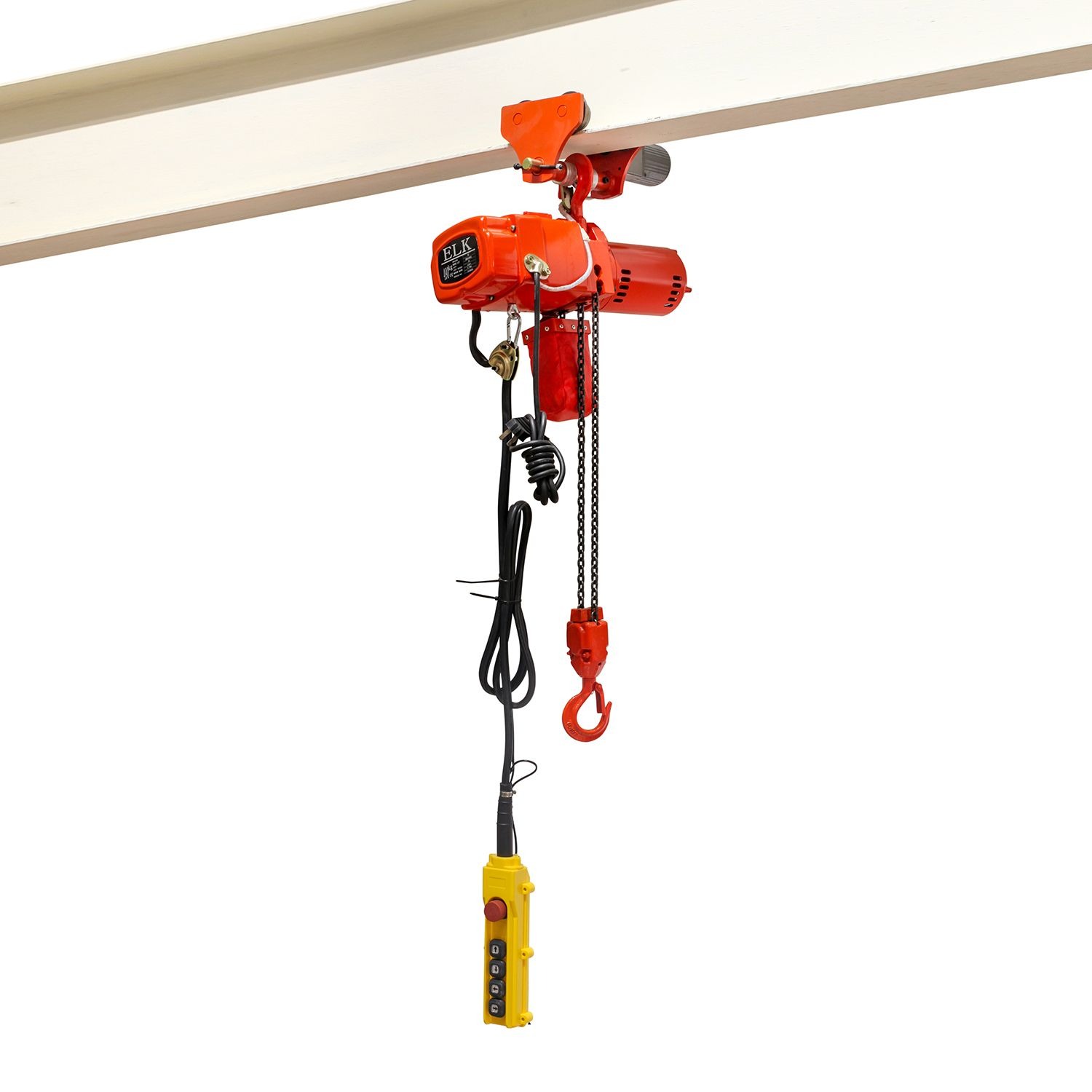
Stationary repetitive lifting requires rigid mounting. Lug mount configurations bolt directly to the structure or trolley. This eliminates swaying and provides a highly stable lifting point. Hook mount configurations offer flexibility. You can move the unit between different anchor points using a secondary crane. However, hook mounts allow more lateral movement and swinging during the lift, which slows down precision placement.
Mobility options dictate how the equipment moves across the workshop beam. Plain push trolleys work for light loads under 2 tons. Operators simply push the suspended load along the beam. Geared trolleys use a hanging hand chain for precise positioning of heavier loads. Motorized trolleys integrate directly into bridge cranes or monorails. They provide effortless, high-frequency lateral movement controlled directly from the pendant.
High-frequency lifting demands robust braking. Dual-braking systems provide necessary redundancy. They combine mechanical load brakes with regenerative or electrical motor brakes. The motor brake stops the motor shaft from turning, while the mechanical brake holds the load securely in the gear train. If one system fails, the other holds the load. This is a non-negotiable safety feature for heavy workshop environments.
Load control relies heavily on motor configuration. Two-speed motors offer a fast speed for bulk movement and a slow speed for precision spotting. Variable Frequency Drives (VFD) provide infinite speed control. VFDs offer several distinct advantages for high-frequency operations:
They allow micro-speed adjustments for setting heavy dies or molds gently.
They ramp up power smoothly, eliminating the mechanical shock of sudden starts.
They use dynamic braking to slow the load before the mechanical brake engages, extending brake pad life by years.
They reduce load swing, making the operator's job significantly safer.
Repeated lifting generates massive thermal loads inside the housing. Finned motor housings increase the surface area for cooling, acting like a giant radiator. Active cooling fans force ambient air over the motor fins. These features are mandatory for high-frequency operations. Without them, the motor will overheat and fail mid-lift.
Internal protection is equally critical. Thermal switches and thermistors monitor internal winding temperatures. They automatically cut power before motor winding damage occurs, forcing a cool-down period. Mechanical slip clutches prevent structural damage during accidental over-capacity lifts by allowing the motor to spin without lifting the load. Electronic overload limiters offer even more precise protection. They measure current draw and stop the lift instantly if the load exceeds capacity.
Operator interface affects both safety and efficiency on the floor. Traditional pendant controls dangle from the equipment. The operator must walk near the load, navigating around floor obstacles. Industrial radio remote controls remove this risk entirely. They allow the operator to stand at a safe distance, out of the fall zone. This improves safety and provides a better vantage point for spotting loads.
Remote controls reduce operator fatigue in high-frequency environments. Operators do not have to drag heavy pendant cables around machinery. Noise reduction also matters for indoor workshops. Helical gearing provides much quieter operation than straight spur gears because the gear teeth engage gradually. This helps facilities maintain compliance with occupational noise exposure limits and improves shop floor communication.
You cannot simply hang heavy equipment on any available beam. Installing a high-capacity, high-speed unit on an inadequate jib crane or bridge beam invites catastrophic failure. The dynamic forces of repeated lifting stress the steel far beyond the static weight of the load. A sudden stop can increase the effective load on the beam by 15% to 25%.
You must conduct a structural engineering audit prior to installation. A certified engineer must verify that the runway beams, columns, and concrete foundations can handle the dynamic loads. The audit process generally includes:
Measuring the flange width and thickness of the existing I-beams or wide-flange beams.
Calculating the maximum wheel loads and impact factors based on the new equipment's specifications.
Inspecting existing welds, bolts, and splice plates for fatigue cracking.
Verifying the concrete floor depth and anchor bolt pull-out strength for jib crane installations.
High-frequency electric hoists require robust electrical support. You cannot run them on shared, overloaded shop circuits. They require dedicated circuits with properly sized breakers. Proper grounding is an absolute necessity to protect operators from electrical faults, especially when operators touch the metal load block.
You must manage voltage drops across long runways. Festoon systems (hanging cables on track rollers) or enclosed conductor bars deliver power to moving trolleys. If the runway is long, the voltage can drop significantly at the far end due to wire resistance. This voltage drop causes the motor to draw more amps to compensate, leading to rapid overheating. You must size your electrical conductors correctly to maintain full voltage across the entire crane span.
Workshop lifting equipment falls under strict regulatory oversight. In the United States, ASME B30.16 governs overhead underhung and stationary hoists. OSHA strictly enforces these standards under general industry regulations. Non-compliance results in heavy fines, facility shutdowns, and massive liability in the event of an accident.
You must perform initial load testing before commissioning new equipment. A certified inspector must test the unit at 125% of its rated capacity. This verifies the brakes hold under extreme stress, the suspension remains intact, and the structural beam does not deflect beyond allowable limits. You must keep documented certification of this test on file at all times for safety audits.
Equipment survives only if operators use it correctly. Operator misuse destroys high-quality machinery faster than heavy loads. Side-pulling a load damages the wire rope guides, bends the chain, and grinds the trolley wheel flanges against the beam. Using the equipment as a tow winch to drag heavy carts across the floor destroys the gearing and voids the warranty.
You must implement mandatory training protocols. Operators must understand the limits of high-frequency operation. They must learn how to center the hook perfectly over the load before lifting. Proper change management mitigates equipment abuse and extends the lifespan of your investment. Operators should perform daily pre-shift inspections, checking the wire rope for broken strands, testing the upper limit switches, and verifying the brakes hold firmly without slipping.
The suitability of lifting equipment for repeated workshop tasks is dictated primarily by its duty cycle rating. Power phase, thermal management capabilities, and alignment with specific load dynamics are equally critical. You cannot rely on weight capacity alone. A properly specified unit guarantees safe, continuous production. An underspecified unit guarantees downtime, burned-out motors, and severe safety hazards.
Follow strict shortlisting logic. Choose a three-phase industrial electric chain hoist for high-frequency, mid-weight, true-vertical lifts in compact spaces. Choose an electric wire rope hoist for high-speed, heavy-tonnage, and long-lift applications. Strictly limit mini electric hoists to intermittent, light-duty workstation tasks.
Take the following actions to secure your lifting operations:
Conduct a comprehensive audit of your daily lift count and maximum load requirements to determine your exact ASME duty cycle needs.
Measure your available electrical power and verify three-phase availability at the installation site to ensure proper motor cooling.
Hire a structural engineer to inspect your existing beam infrastructure and verify dynamic load capacities before purchasing equipment.
Consult with a certified overhead lifting equipment specialist to finalize your equipment specifications and arrange for mandatory 125% load testing.
A: Wire rope hoists use steel cables wrapped around a grooved drum. They excel at high-speed, heavy-tonnage lifting and offer very smooth operation. Chain hoists use steel links driven by a pocketed sprocket. They are highly durable, provide true vertical lifts without lateral drift, and are ideal for mid-capacity repetitive tasks in harsh environments.
A: Three-phase power delivers continuous, smooth electrical current. This allows the motor to draw fewer amps per phase. It eliminates the need for vulnerable start capacitors. As a result, three-phase motors generate significantly less heat during repeated lifting cycles, preventing premature thermal failure.
A: You must calculate your maximum lifts per hour and your active operating time per hour. Compare these metrics against ASME (H3, H4, H5) or FEM ratings. If your workshop operates continuously across multiple shifts, you require an H4 or H5 rating to handle the thermal load.
A: Mini hoists are designed for intermittent use on single-phase power. Using them for continuous production will cause rapid thermal overload. The start capacitors will likely melt, the motor windings will burn out, and the equipment will fail completely within a very short timeframe.
A: The 80% rule states that your average daily load should not exceed 80% of the hoist’s maximum rated capacity. This buffer prevents the motor and braking systems from constantly operating at their absolute thermal and mechanical limits, significantly extending the equipment's lifespan.
A: Side-pulling occurs when the hoist is not centered directly over the load. This forces the wire rope or chain to scrape against the guides. It causes severe wear, can lead to wire rope bird-caging, and puts dangerous lateral stress on the trolley and supporting beam infrastructure.


