loading


| Availability: | |
|---|---|
| Quantity: | |


◆◆ Product Advantage
1. Exceptional Lifting Capacity and Robust Construction for Heavy-Duty Applications
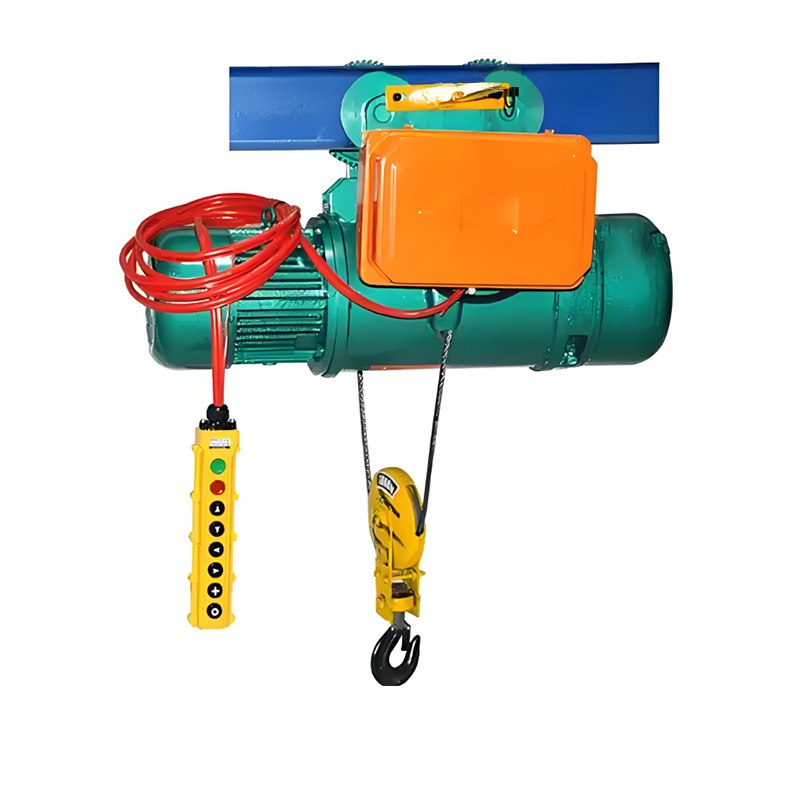
Our wire rope hoists are engineered to manage substantial loads with ease, offering capacities ranging from 1 ton to 30 tons and beyond. The core of this strength lies in the high-tensile steel wire rope, resistant to abrasion and crushing, and the rugged load chain or drum assembly. The housing is typically constructed from high-grade steel, providing superior protection against impact and deformation. This robust design ensures reliable performance in the most demanding settings, such as steel mills, shipping yards, and heavy equipment manufacturing facilities, minimizing the risk of failure under extreme loads. heavy-duty wire rope hoist
2. High-Efficiency Motor and Advanced Ergonomics for Enhanced Productivity
Equipped with high-torque, thermal-protected motors, our hoists deliver optimal power while ensuring energy efficiency. Many models feature variable speed control, allowing for precise load positioning and smooth, shock-free starts and stops. This precision is crucial for handling delicate or expensive goods. The ergonomic design, including lightweight push-button pendants, reduces operator fatigue, leading to increased productivity and a safer working environment over long shifts. high efficiency wire rope hoist motor
3. Superior Safety Systems and Reliability for Risk Mitigation
Safety is paramount. Our hoists integrate multiple redundant safety features. The primary failsafe brake system is typically a magneto-mechanical disc brake that engages automatically in the event of a power loss. Additional safety may include an upper limit switch to prevent over-hoisting, a thermal overload protector for the motor, and a low-voltage control system for operator safety. These features provide peace of mind, ensuring compliance with stringent international safety standards and protecting both your personnel and your valuable assets. wire rope hoist safety features
4. Durable Design and Low Maintenance Requirements for Reduced TCO (Total Cost of Ownership)
Built for longevity, our hoists feature components designed for easy access and serviceability. The hardened steel gears run in an oil bath for efficient lubrication and reduced wear. Sealed bearings and protective coatings guard against contaminants like dust and moisture. This robust construction, coupled with extended maintenance intervals, significantly reduces downtime and lifecycle costs, ensuring a rapid return on investment and making it a cost-effective solution for continuous operation. low maintenance industrial wire rope hoist
◆◆ Technical Parameters
| Rated Lifting Capacity | 1t, 2t, 3t, 5t, 10t, 15t, 20t, 25t, 30t, 50t |
| Lifting Height | Standard: 6m, 9m, 12m, 18m, 24m, 30m |
| Lifting Speed | Single-speed: ~8 m/min; Two-speed/VVF: ~2/8 m/min or adjustable |
| Travelling Speed | Push-type: ~20 m/min; Cab/Remote: ~30 m/min |
| Duty Cycle / Class of Service | 1Am, 1Bm, 1Cm, 2m, 3m, 4m |
| Motor Power | e.g., 1.5kW (for 2t), 3.7kW (for 5t), 7.5kW (for 10t) |
| Power Supply | 3-Phase 380V/400V/415V, 50Hz |
| Wire Rope Specification | e.g., Φ7.4mm, Φ11mm, Φ13mm |
| Safety Devices | Upper limit switch, overload protection, emergency stop, phase sequence protection |
| Key Dimensions | Determined by capacity and model (e.g., Hmin: 800mm - 1500mm) |
| Net Weight | e.g., ~200kg for 2t model, ~800kg for 10t model |
◆◆ Product Uses
1. Manufacturing and Assembly Shops
In machinery manufacturing, automotive, and equipment assembly plants, wire rope hoists are the backbone of material handling. They are used for precise positioning of heavy components during the assembly process, such as installing engines, moving large machine parts, or handling raw materials like steel plates. Their robust construction allows for frequent use in workshop environments, significantly improving production efficiency and workflow safety.
2. Warehousing and Logistics Centers
In large-scale warehouses and distribution hubs, wire rope hoists, often integrated into overhead crane systems, are essential for handling heavy or bulky goods. They efficiently load and unload palletized materials, heavy equipment, and large containers from trucks and position them within storage racks. Their high lifting speed and durability support the fast-paced operations required in modern logistics, ensuring quick turnaround times.
3. Construction and Heavy Engineering Projects
On construction sites and for major infrastructure projects, wire rope hoists play a vital role in lifting and placing heavy materials. They are used for tasks such as hoisting steel reinforcement bars, concrete panels, pre-cast structures, and large-diameter pipes. Their high lifting capacity and ability to operate reliably in demanding site conditions make them crucial for meeting project timelines and ensuring job site safety.
4. Metal and Mining Industry
In steel mills, foundries, and mining operations, wire rope hoists operate in extreme conditions involving heat, dust, and heavy loads. They are used for transporting molten metal in foundries, handling coils of finished steel, and maintaining heavy machinery. Special designs, such as high-temperature or explosion-proof models, are available to meet the specific safety and performance requirements of these harsh environments.
5. Power Generation and Shipbuilding
In power plants (thermal, hydro, nuclear) and shipyards, the demands for lifting capacity and precision are exceptionally high. Wire rope hoists are used for critical tasks like turbine installation and maintenance in power plants, and for moving large ship sections, engines, and propellers during vessel construction and repair. Their reliability is paramount for these high-value, high-risk operations.
6. Ports and Rail Maintenance
While larger cranes typically handle primary ship-to-shore operations, wire rope hoists are widely used within port facilities for warehouse management, equipment maintenance, and rail yard operations. They are also essential in railway depots for lifting heavy components during the maintenance and repair of locomotives and rail cars.
◆◆ Product Operate Guide
To ensure safe and efficient operation, always follow these steps. Before use, inspect the hoist, wire rope, and hook for any damage. Never exceed the rated load capacity. During lifting, center the load below the hook and lift smoothly without jerking. Do not allow anyone to stand under a suspended load. Use the control pendant to move the load steadily, avoiding sudden stops. After use, raise the hook to a safe position and power off the unit. Regular maintenance is essential for long-term reliability.
◆◆ Product Video
◆◆ FAQ
Q1: What is the main difference between a wire rope hoist and a chain hoist?
A1: Wire rope hoists are designed for heavier loads (typically 2 tons and above) and higher lifting speeds, making them ideal for intensive industrial use. They are more durable against abrasion but have a larger minimum hook approach. Chain hoists are more compact and suitable for lighter, less frequent tasks.
Q2: How often does a wire rope hoist require maintenance?
A2: Maintenance frequency depends on usage intensity (duty class). For regular use, a basic inspection should be done before each shift. Professional maintenance is recommended every 3-6 months for standard service (1Bm-3m) or every 1-3 months for heavy-duty (4m) applications to ensure safety and longevity.
Q3: Can the lifting speed be controlled for precise positioning?
A3: Yes. Many modern electric wire rope hoists offer variable frequency control (VVF), allowing for precise, slow-speed movement and smooth acceleration/deceleration. This is essential for accurate load positioning, handling delicate goods, and ensuring operational safety in confined spaces.
Q4: What safety features are essential on a standard wire rope hoist?
A4: Key safety features include an upper limit switch to prevent over-hoisting, an overload limiter, a fail-safe electromagnetic brake, and thermal protection for the motor. Optional features like a lower limit switch or dual braking systems provide additional protection for critical applications.
Q5: Can I use a standard wire rope hoist in outdoor or harsh environments?
A5: Standard hoists are for indoor use. For outdoor, corrosive, or explosive atmospheres, you need specially designed hoists with features like higher IP (Ingress Protection) ratings (e.g., IP65), corrosion-resistant coatings, or explosion-proof certifications (ATEX, IECEx) to ensure safe and reliable operation.

Buying an electric pallet truck? Uncover hidden lifecycle fees, compare lithium vs lead-acid batteries, and avoid costly procurement mistakes.

Eliminate warehouse bottlenecks and manual lifting fatigue. Discover how the right electric pallet truck boosts throughput, safety, and ROI.

Forklift or electric pallet truck? Eliminate bottlenecks by matching the right material handling equipment to your warehouse workflow and space.

Choosing between electric and manual chain hoists? Prevent costly specification errors by comparing duty cycles, costs, and safety in this guide.

Maximize warehouse throughput. Learn how to select the right electric pallet truck by evaluating load realities, duty cycles, and battery types.

Avoid liability & OSHA fines. Learn proper chain hoist inspection intervals: daily to annual, based on service class, per ASME B30.16. Stay safe.

Stop guessing chain hoist capacity. Use this method: add 25% safety margin, factor rigging weight, and match duty cycles for safe, efficient lifting.

Discover safe manual chain hoist setup steps, pre-lift tests, and compliance tips to prevent catastrophic load drops and ensure workplace safety.

Calculate lift height for manual chain hoists with our guide. Prevent dangerous tail chain hazards. Ensure OSHA-compliant rigging. Order correctly.

Stop risking safety with wrong chain hoist specs. Calculate true load, duty cycles, & ensure compliance. Expert guide.

Master electric pallet truck safety and operations. Learn essential SOPs, daily checks, and key features to prevent accidents and boost efficiency.

Maximize electric pallet truck battery life. Compare lead-acid vs. lithium-ion runtimes, lifespans, and maintenance to prevent costly downtime.

Reduce operator fatigue and boost warehouse efficiency with the right electric pallet truck. Learn to select models, battery types, and capacity.

Confused by electric pallet truck jargon? Learn to choose the right walkie, rider, or stacker to maximize warehouse efficiency and boost ROI.

Is a powered pallet truck legally a forklift? Yes. Learn OSHA classifications, mandatory training, and key differences to avoid costly fines.

Industrial lifting carries immense high-stakes realities. Choosing the wrong lifting equipment exposes operations to severe payload damage, strict regulatory penalties, and catastrophic safety failures.

Synthetic rigging drives modern material handling across construction, manufacturing, and logistics. Within this demanding field, the Type 3 flat eye-and-eye configuration stands out as the industry’s default workhorse. It balances immense lifting power and everyday practicality.

Selecting the right lifting sling goes far beyond merely checking a weight capacity chart. It represents a critical safety and operational efficiency decision shaping your entire Total Cost of Ownership (TCO).

Lifting massive industrial loads leaves zero room for error. Selecting the wrong lifting sling doesn't just risk operational downtime. It introduces catastrophic safety liabilities and inflates equipment replacement costs instantly.

While the "3-3-3 rule" recently trended across various fitness platforms, it holds a drastically different meaning in industrial material handling. In the high-stakes environment of industrial lifting, it represents a non-negotiable operational safety and rigging framework.


