
Views: 0 Author: Site Editor Publish Time: 2026-07-16 Origin: Site


Selecting industrial lifting equipment goes far beyond a simple weight-matching exercise. You must treat this decision as a critical risk-management strategy. A poorly specified lifting system introduces severe safety risks into your daily operations. If you underspecify your equipment, you risk premature mechanical failure. You also face serious safety violations under strict OSHA and ASME regulations. Conversely, overspecifying leads to wasted capital expenditure. It creates unnecessary spatial constraints and a severe loss of operational headroom.
To avoid these costly mistakes, you need an engineering-led framework. We will guide you through calculating true load demands and analyzing operational duty cycles. We also evaluate power configurations and assess your site infrastructure constraints. You will learn how to specify the correct Chain Hoist for your facility. This ensures long-term reliability and complete regulatory compliance. Our comprehensive guide empowers you to make informed, safe, and efficient purchasing decisions.
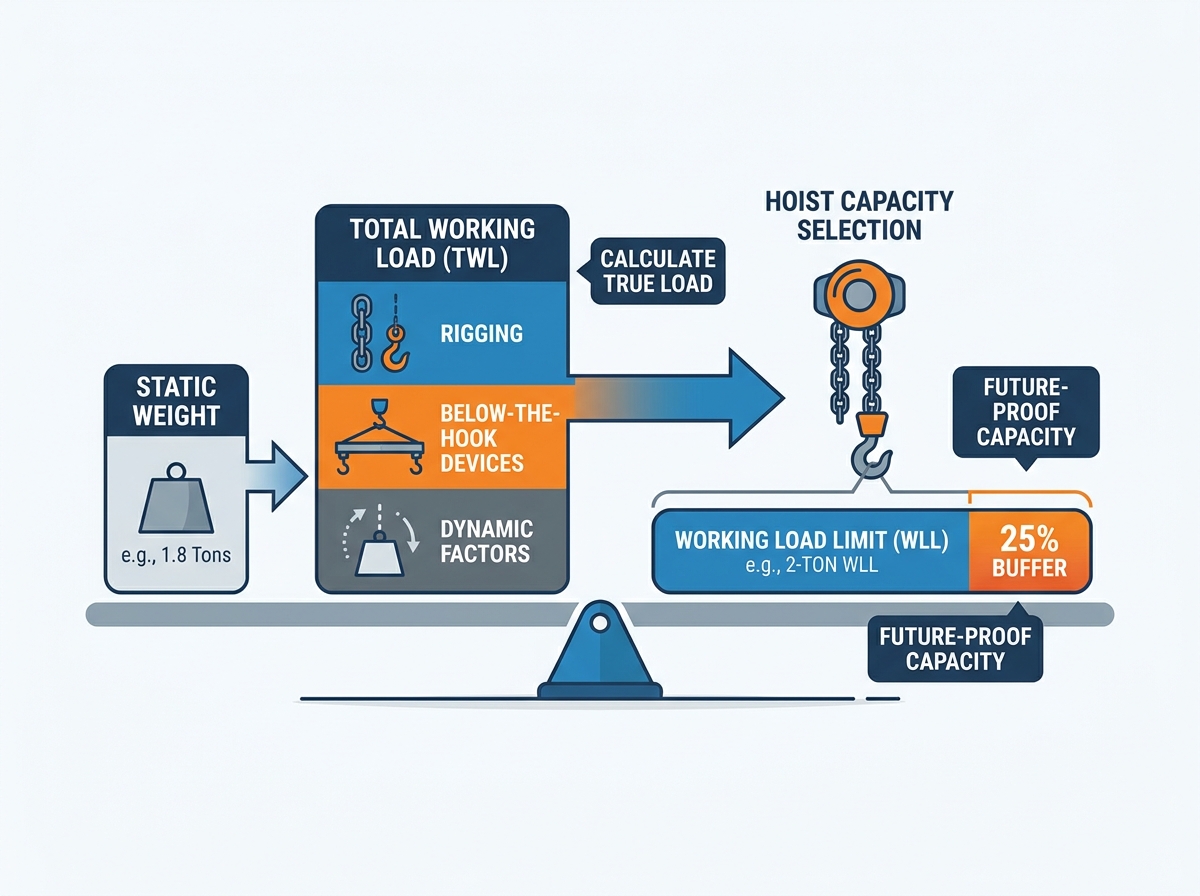
Capacity selection requires calculating the Total Working Load (TWL), including all rigging, below-the-hook devices, and dynamic forces—not just the static object weight.
Matching the hoist to your operational duty cycle (ASME/CMAA classifications) is equally as important as the maximum weight rating.
Infrastructure constraints (beam capacity, available headroom, power supply) dictate which hoist configurations are viable.
Standardizing on recognizable safety certifications and verifiable testing documents is mandatory for industrial compliance.
Many facility managers make a critical mistake during capacity planning. They only evaluate the static weight of the target object. This flawed approach ignores the daily realities of industrial rigging. You must calculate the Total Working Load (TWL) instead. The TWL includes the bare item alongside all below-the-hook devices. You must add the exact mass of hooks, spreader beams, and slings. Custom lifting attachments also contribute significantly to the total weight. If your bare load weighs 3,500 pounds, your rigging might add another 500 pounds. This immediately pushes your actual requirement up to a full two tons.
You must also account for dynamic loading factors. Static weight rarely reflects the true forces acting on your lifting equipment. Sudden starts and stops multiply the effective force on the lifting mechanism. Load shifting during transit creates unpredictable stress spikes. When you accelerate a load quickly, the momentary force drastically exceeds the static weight. A heavy mold pulled from a tight casting machine creates suction forces. These forces act as massive dynamic multipliers during the initial lift. You need equipment fully capable of handling these dynamic multipliers safely.
Industry best practice dictates applying a strict engineering buffer. Professionals commonly call this the 20-25% rule. You should never plan to operate any lifting device at its absolute maximum capacity. If your calculated TWL reaches 1.8 tons, do not buy a 2-ton unit. You should specify a 3-ton model instead. This buffer accommodates unexpected future operational shifts seamlessly. It prevents operators from accidentally violating the Working Load Limit (WLL) later.
Evidence-based safety relies entirely on strict adherence to manufacturer guidelines. You must respect the stated WLL at all times. Do not rely on built-in mechanical overload clutches for routine operations. Manufacturers design these clutches purely as emergency fail-safes. They prevent catastrophic structural failure during an accidental overload event. If operators routinely trigger the overload clutch, they are abusing the equipment. This reckless practice destroys the clutch mechanism rapidly. It also voids your manufacturer warranty and violates workplace safety protocols.
Capacity alone presents an incomplete picture of your true lifting requirements. A unit rated for two tons will fail rapidly if operators exceed its intended frequency. This premature failure occurs even if they only lift 1.5 tons at a time. The frequency of use dictates the internal wear on gears, bearings, and motors. You must match the equipment perfectly to your actual operational tempo.
The American Society of Mechanical Engineers (ASME) publishes strict guidelines for this. They categorize lifting equipment into specific duty classifications. You must select the right class to ensure long-term mechanical longevity.
ASME Hoist Duty Classifications Summary
Classification | Operational Duty | Typical Applications |
|---|---|---|
H2 | Light Duty | Infrequent lifting, standby operations, standard maintenance tasks. |
H3 | Standard Duty | General machine shop fabrication, intermittent daily use. |
H4 | Heavy Duty | High-volume manufacturing, repetitive handling, steel warehousing. |
Electric models require specific motor considerations beyond the ASME class. You must evaluate the maximum starts per hour rating carefully. You also need to verify the maximum continuous on-time limit. Many standard electric models offer only a 30-minute continuous rating. If you run the motor longer, you risk severe thermal overload. Underspecified electric motors overheat quickly during high-volume operations. This damages internal winding insulation and leads to premature motor burnout. Upgrading to a higher duty cycle prevents these costly thermal failures entirely.
Your available power supply directly influences your final capacity decisions. Different power types suit very different industrial environments. You must align the primary power source with your operational demands.
Manual models rely entirely on human physical effort.
Best for: Precise spotting and highly infrequent lifts. They excel in remote environments lacking utility connections. Spark-resistant manual models work perfectly in volatile or explosive atmospheres.
Limitation: Operator fatigue severely limits practical capacity in high-cycle scenarios. You cannot use manual models for fast-paced production lines. Lifting a heavy load manually takes considerable time and extreme physical exertion.
Electric units dominate most modern manufacturing floors today.
Best for: They handle demanding H3 and H4 duty cycles effortlessly. They provide consistent lifting speeds and integrate seamlessly with safety limit switches. They reduce operator fatigue completely.
Requirement: You must verify your facility voltage availability early in the process. You need to decide between single-phase and three-phase power options. Three-phase power generally supports much higher capacities and heavier duty cycles. You must match the electrical specifications exactly to your site utilities.
Air or pneumatic models utilize compressed air instead of electrical current.
Best for: They offer 100% continuous duty cycles reliably. They completely lack an internal electric motor to overheat. They thrive in extreme environments and easily fulfill strict explosion-proof requirements.
Requirement: You need adequate air compressor capacity at your facility. You must verify both CFM (Cubic Feet per Minute) and PSI (Pounds per Square Inch). The compressor system must support the equipment continuously at full load.
Your facility's physical infrastructure ultimately dictates what equipment you can safely install. You cannot specify a Chain Hoist without validating your structural realities first.
Headroom constraints often force engineers to alter their final equipment choices. Headroom defines the vertical distance from the supporting beam to the load hook. Older facilities frequently suffer from limited vertical workspace. Standard pendant models require significant headroom to house the motor and chain bag. If your vertical space is tight, you must evaluate low-headroom configurations. These specialized designs mount the motor horizontally parallel to the beam. This reclaims precious vertical space and maximizes your overall lifting height.
Structural support validation remains a non-negotiable workplace safety requirement. The lifting capacity cannot ever exceed the certified capacity of your supporting structure. You must check the official rating of the jib crane, gantry, or overhead I-beam. If your overhead I-beam holds a maximum of two tons, you cannot install a three-ton lifting unit. Doing so creates a massive catastrophic structural failure risk. You must consult a licensed structural engineer if you lack certified load ratings for your beams.
Trolley integration also impacts your overall capacity and workflow efficiency. The trolley mechanism moves the lifting unit horizontally along the supporting beam. You can choose between push/pull, geared, and fully motorized trolleys. Push/pull trolleys work well for lighter loads where operators can manually push the load safely. Geared trolleys use a dedicated hand chain for better control of heavier items. Motorized trolleys match high-capacity electric units perfectly. The chosen trolley must match both the beam flange width and the maximum capacity rating. If you install a trolley on an incompatible beam flange, it will bind or derail during operation.
You need a systematic approach to narrow down your available equipment options. Follow this straightforward framework to finalize your technical specifications safely.
Document the Operational Envelope: Write down your exact maximum load first. Add the total weight of all required rigging equipment. Measure your required lift height carefully. This measurement dictates the total required length of the lifting chain. Finally, calculate the estimated lifts per hour to determine your exact duty cycle.
Filter by Environment and Power: Eliminate any models failing to match your site utility realities immediately. For example, never specify a 460V three-phase unit where only 115V single-phase power exists. Remove electric models entirely if your environment requires strictly explosion-proof pneumatic equipment.
Verify Compliance and Safety Features: Shortlist only models featuring officially verifiable load testing certificates. Ensure strict product compliance with current ASME B30.16 standards. Verify the presence of essential safety mechanisms. You need upper and lower limit switches to prevent dangerous chain over-travel. You also require reliable mechanical load brakes to hold the load securely if site power fails.
Specifying a Chain Hoist demands a careful balancing act. You must align your load data, duty cycle requirements, and site infrastructure perfectly. Treating this process as a mere purchasing task introduces unacceptable operational risks. A well-specified unit improves workflow efficiency and guarantees daily operator safety.
Always calculate the Total Working Load instead of just the static load weight.
Never purchase industrial lifting equipment based on upfront price alone.
The severe liability costs of a dropped load far exceed any savings gained from an underspecified unit.
Match your power supply and structural headroom precisely to avoid costly installation delays.
Your next step requires professional engineering validation. We strongly recommend consulting with a certified rigging engineer. You should request a comprehensive technical quote based strictly on your specific application data.
A: Yes, provided it is properly maintained and operates within its intended duty cycle. However, industry best practice strongly suggests maintaining a 20-25% capacity buffer. This safety margin accounts for unexpected dynamic forces and extends the longevity of internal mechanical components.
A: Evaluate your Total Working Load carefully. If your daily operational load consistently hovers at or near 2,000 lbs, you should upgrade to a 2-ton model immediately. The larger capacity reduces motor strain, prevents thermal overload, and extends the operational life of the equipment.
A: WLL represents the maximum load the manufacturer authorizes the equipment to handle safely. SWL is an older, outdated industry term. Modern rigging standards generally replace SWL with WLL to prevent ambiguity and standardize global safety compliance documentation.
A: Yes, they absolutely do. ASME standards strictly require a rated load test prior to initial use. You must also perform this test following major equipment repairs or after making any significant modifications to the supporting physical structure.


