
Views: 0 Author: Site Editor Publish Time: 2026-08-21 Origin: Site


Transitioning from manual to motorized material handling represents a major operational upgrade for any facility. Many operations delay this transition due to opaque expense structures and hidden lifecycle fees. Procurement teams often struggle to evaluate the initial capital expenditure against ongoing operational expenses. The sticker figure you see on an invoice represents only a fraction of the total financial commitment required to keep your equipment running efficiently over its lifespan.
This guide breaks down the exact investment factors you must consider before purchasing an electric pallet truck. We will evaluate the financial and environmental impact of different battery technologies, compare procurement channels, and provide a comprehensive framework for calculating long-term operational expenses. By understanding these variables, you can align your equipment choices with your actual facility throughput and avoid costly procurement mistakes.
Baseline Price Ranges: Standard new models range from entry-level semi-electric units to heavy-duty, ride-on models.
The Battery Premium: Upgrading to a lithium battery electric pallet truck increases upfront costs but typically yields a positive ROI within 12-18 months through zero-maintenance, opportunity charging, and lower energy consumption.
Hidden Lifecycle Factors: Maintenance, shipping/freight fees, charging infrastructure, and downtime often exceed the initial purchase price over a 5-year lifecycle.
Procurement Strategy: Sourcing channels (manufacturer direct vs. local dealer) and volume fleet discounts significantly alter the final per-unit cost.
Application-Specific Sizing: Over-specifying capacity or under-specifying battery endurance are the two most common procurement errors leading to wasted budget.
Procurement teams must align the initial capital outlay with the actual throughput requirements of their facility. Over-investing ties up valuable capital. Under-investing leads to premature equipment failure and excessive downtime. Understanding the distinct categories of motorized jacks helps you match the machine to your operational reality on the warehouse floor.
Semi-electric models feature a motorized drive mechanism but rely on manual hydraulic pumping to lift the load. These units are typically rated for capacities between 2,200 and 3,300 pounds. They represent the most budget-friendly entry point into motorized material handling.
These units excel in low-volume retail environments, crowded backrooms, and delivery routes requiring lift-gate operations. They reduce the physical strain of pushing heavy loads. This lowers the risk of workplace injuries and workers' compensation claims. However, they possess a shorter operational lifespan. They demand more physical effort from operators compared to fully motorized alternatives. Facilities with continuous, high-volume movement will quickly outgrow this equipment tier. If your team moves pallets across a warehouse floor all day, a semi-electric unit will burn out its drive motor within months.
Standard walkie models feature fully motorized lift and drive capabilities. They typically handle capacities ranging from 3,000 to 4,500 pounds. This category serves as the backbone for most mid-volume, single-shift operations.
A reliable warehouse electric pallet truck in this class delivers consistent performance without operator fatigue. Investment variables in this category depend heavily on brand reputation, custom fork dimensions, and integrated features like digital weigh scales. These units strike a balance between capability and cost. They are ideal for standard distribution centers and manufacturing floors. When you spec these machines, look closely at the tiller arm ergonomics. Operators will hold that handle for eight hours a day. Poor ergonomics lead to wrist strain and reduced productivity.
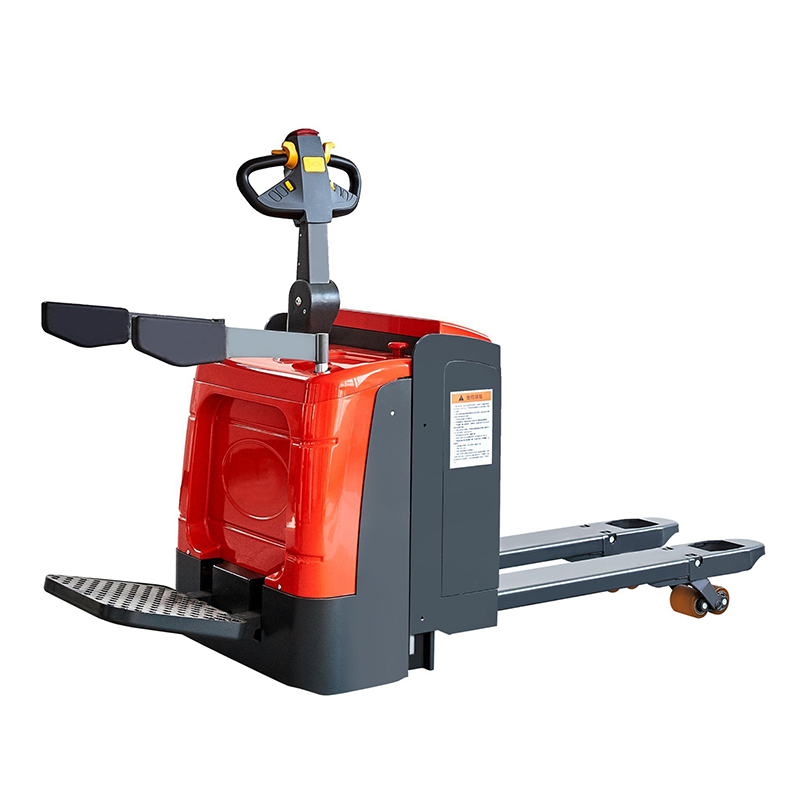
Heavy-duty models handle capacities exceeding 6,000 pounds. They often feature integrated operator platforms, advanced ergonomic controls, and heavy-duty steel chassis construction. These machines are engineered for high-throughput distribution centers, cross-docking operations, and facilities requiring long-distance transport.
The higher initial outlay for ride-on models is justified through significant labor savings. Operators travel at higher speeds and experience less fatigue over an eight-hour shift. When a facility requires moving heavy loads across distances exceeding 200 feet regularly, ride-on units become a mandatory operational requirement. Walking a standard jack across a massive distribution center wastes hours of labor each week. Ride-on units keep your team moving fast and efficiently.
Purchasing used or refurbished equipment offers immediate capital savings. Procurement teams often look to this market to stretch limited budgets. However, evaluating the remaining lifecycle of a refurbished unit requires strict due diligence.
The most significant hidden trap in the used market is battery degradation. A used unit might seem like a bargain until you realize the battery holds only a fraction of its original charge. The expense of replacing a degraded industrial battery often negates the initial discount entirely. Always demand a certified battery load test before authorizing the purchase of used motorized material handling equipment. Check the hour meter on the drive motor. High hours mean the internal brushes and commutators are likely nearing the end of their service life.
The choice of power source dictates the upfront cost, operational workflow, energy efficiency, and carbon footprint of your entire shift. Battery technology has evolved rapidly. This presents facilities with major decisions regarding their power infrastructure.
Traditional lead-acid batteries require a lower initial investment. However, they demand rigorous ongoing maintenance. Operators must perform weekly watering, regular equalization charging, and terminal cleaning. Lead-acid batteries also require dedicated, ventilated charging rooms due to the risk of off-gassing explosive hydrogen during the charge cycle. The hidden labor expenses associated with this maintenance quickly accumulate.
Conversely, a lithium battery electric pallet truck requires a higher initial outlay but offers a zero-maintenance experience. Lithium-ion cells do not require watering or dedicated ventilation. They support opportunity charging. Operators can plug the unit into a standard wall outlet during a 15-minute break. This technology also boasts a significantly longer cycle life. They often exceed 3,000 charge cycles before noticeable degradation occurs.
Feature | Lead-Acid Battery | Lithium-Ion Battery |
|---|---|---|
Maintenance Required | Weekly watering, terminal cleaning, equalization | Zero maintenance required |
Charging Speed | 8-10 hours full charge, plus cool-down time | 1-2 hours fast charge, supports opportunity charging |
Lifespan (Cycles) | 1,000 - 1,500 cycles | 3,000+ cycles |
Ventilation Needs | Dedicated charging room required for off-gassing | No special ventilation needed |
Weight | Very heavy, requires hoist for swapping | Lightweight, often fixed inside the unit |
Multi-shift operations require equipment that can run continuously without long charging interruptions. High Amp-hour (Ah) batteries provide the necessary runtime to sustain aggressive operational tempos.
When evaluating a long-endurance electric pallet truck, you must calculate the cost-to-benefit ratio. Purchasing one long-endurance lithium unit often proves more economical than buying two standard lead-acid units to swap mid-shift. The single lithium unit eliminates the need for expensive battery extraction equipment. It saves extra storage space. It removes the labor downtime associated with physical battery swaps. Your operators stay on the floor moving product instead of wrestling with heavy battery hoists in the maintenance bay.
Lithium-ion technology delivers superior power transfer efficiency compared to legacy lead-acid systems. Less electrical energy is lost as heat during the charging process. This efficiency directly reduces monthly utility bills. It lowers the overall carbon footprint of your logistics operation.
Many regions offer tax incentives, utility rebates, and sustainability grants for facilities upgrading to energy-efficient fleets. Leveraging these localized programs can significantly offset the premium associated with advanced battery chemistries. Check with your local power provider. They often have commercial rebate programs for warehouses that transition away from inefficient legacy charging systems.
The true financial impact of motorized material handling equipment extends far beyond the initial purchase. A comprehensive breakdown of operational expenses incurred over a standard three-to-five-year lifecycle reveals where budgets typically leak.
Heavy machinery freight fees significantly impact the final invoice. Moving industrial equipment requires Less Than Truckload (LTL) shipping. This fluctuates based on fuel surcharges and routing distance.
Facilities without dedicated loading docks face additional lift-gate delivery surcharges. Furthermore, some units arrive partially disassembled. You must account for the internal labor or third-party technician fees required for on-site assembly. Hydraulic fluid top-offs, greasing zerks, and initial safety commissioning must happen before the unit enters active service. Do not assume the machine is ready to work the moment it rolls off the delivery truck.
You should anticipate annual maintenance expenses to equal roughly 10 to 15 percent of the initial purchase outlay. Motorized jacks endure harsh physical environments. They require regular component replacement to remain safe and operational.
High-wear components include:
Polyurethane load wheels and rubber drive tires
Electrical contactors and wiring harnesses
Hydraulic seals and O-rings
Control tiller buttons and emergency reverse switches
Forks and load backrests subject to impact damage
Establishing a preventative maintenance schedule minimizes catastrophic failures. Replacing a worn drive tire is inexpensive. Replacing a burned-out drive motor because the worn tire caused excessive vibration is a major capital expense. Train your operators to report chunked wheels immediately.
High-draw industrial chargers may require facility electrical upgrades. If your building lacks the necessary three-phase power or sufficient amperage at the breaker panel, you will incur significant electrician fees before you can even plug the equipment in.
Energy consumption also varies by battery type. Inefficient legacy chargers waste electricity, driving up utility costs. Upgrading to smart chargers that automatically taper the electrical current can mitigate these ongoing utility expenses. Smart chargers communicate with the battery management system. They only deliver the exact amount of power needed, preventing overcharging and grid waste.
OSHA compliance mandates strict training protocols for anyone operating motorized material handling equipment. Standard manual pallet jacks do not require certification. The moment you introduce an electric drive motor, OSHA standard 1910.178 applies.
Facilities must absorb the time and labor costs associated with initial classroom instruction. Practical hands-on evaluation and mandatory certification renewals take operators off the floor. Failing to maintain these training records exposes the company to severe compliance fines. It increases liability in the event of a workplace accident. Budget for a dedicated safety trainer or a third-party certification service.
Procuring a budget-friendly unit that cannot navigate your specific facility layout will cost you exponentially more in damaged goods, structural repairs, and lost productivity. You must match the machine's specifications to your physical environment.
Calculating required capacity involves more than just weighing your heaviest pallet. You must account for dynamic forces during transit and the load center of the materials. A standard rule of thumb is to specify equipment with a capacity rating 10 to 20 percent above your maximum expected load.
Standard forks measure 27 inches wide by 48 inches long. If your facility handles oversized materials, beverage pallets, or custom manufacturing skids, you will need non-standard fork dimensions. Custom fork lengths or widths carry an acquisition premium. They prevent catastrophic load instability. Trying to move a 60-inch skid with 48-inch forks will eventually result in dropped product and damaged inventory.
The turning radius of the equipment dictates your racking layout. If a unit requires a wide turning radius, you lose valuable floor space to wider aisles. Right-angle stacking capabilities are crucial for tight storage environments.
Flooring conditions directly impact motor wear and tire selection. Uneven concrete, steep dock plates, and floor gradients force the drive motor to work harder. This increases operating temperatures. Polyurethane tires offer excellent durability on smooth warehouse floors. Softer rubber compounds provide better traction on wet or uneven surfaces. If your dock plates have severe lips, the constant impact will destroy standard load wheels. You may need to spec tandem load wheels to distribute the impact force.
Specialized environments require specialized equipment modifications. Operating in cold storage or freezer applications causes standard hydraulic fluids to thicken. Electrical connections become brittle. Cold storage conditioning packages include specialized fluids, sealed components, and internal heaters. These modifications increase the initial outlay.
Corrosive environments require wash-down capabilities. Food processing plants, pharmaceutical facilities, or chemical handling areas destroy standard steel quickly. Galvanized or fully stainless steel models resist rust and bacterial growth. They require a significantly higher investment compared to standard painted steel units. Do not put a standard painted jack into a meat processing plant. The harsh cleaning chemicals will strip the paint and rust the chassis within weeks.
Strategic procurement neutralizes common implementation pitfalls that inflate expenses post-purchase. Understanding how to navigate the supply chain and negotiate terms protects your operational budget.
Purchasing direct from the manufacturer often yields lower upfront pricing by eliminating the middleman. However, this route usually provides limited post-sale support. If a unit breaks down, you may wait weeks for a factory technician or replacement part to arrive.
Purchasing through a local authorized dealer involves a markup, but it secures localized support. Dealers maintain local parts inventories. They offer rental fleets during extended repairs. They dispatch technicians rapidly. For high-throughput operations where downtime halts revenue, the dealer markup acts as an essential insurance policy.
Scaling your equipment orders unlocks tiered manufacturer discounts. Purchasing multiple units simultaneously reduces the per-unit freight costs significantly. If your facility anticipates growth, consolidating your material handling procurement into a single fleet order yields better financial terms than buying individual units sporadically throughout the year. Talk to your procurement department about forecasting needs 12 to 18 months out.
Over-specification drains capital budgets unnecessarily. Procurement teams sometimes purchase heavy-duty, ride-on models for light-duty retail environments under the assumption that bigger is always better. Implement a strict evaluation framework. Ensure you only pay for the capacity, speed, and battery endurance that your specific throughput data justifies. If a jack only moves three pallets a day from a delivery truck to a backroom, a heavy-duty ride-on model is a massive waste of capital.
Never accept a warranty at face value. You must read the fine print and differentiate between the various coverage tiers. Structural warranties cover the steel chassis. Parts and labor warranties cover mechanical failures. Battery warranties often feature pro-rated replacement schedules based on charge cycles.
A robust Service Level Agreement (SLA) with a local dealer holds immense financial value. Guaranteed response times from service technicians ensure your equipment returns to active duty swiftly. This minimizes the cascading costs of operational downtime. Negotiate a four-hour response time for critical equipment failures.
Outright purchasing makes sense for cash-rich operations looking to maximize asset depreciation. However, leasing offers distinct advantages for rapidly evolving facilities.
Capital leases allow you to eventually own the equipment while spreading the payments out. Operating leases allow you to return the equipment at the end of the term. This ensures you always operate modern, efficient machinery. For seasonal businesses experiencing temporary volume spikes, short-term rentals prevent you from carrying excess equipment inventory during slow months.
Conduct a comprehensive facility audit measuring your narrowest aisles, steepest gradients, and maximum pallet weights to establish baseline equipment specifications.
Analyze your shift structures to determine if opportunity charging with lithium-ion technology will eliminate the need for secondary batteries and dedicated charging rooms.
Calculate potential volume discounts by forecasting your equipment needs for the next 24 months before approaching dealers for quotes.
Request detailed preventative maintenance schedules and SLA response times from potential vendors to evaluate long-term support capabilities.
A: Traditional lead-acid batteries typically last 3 to 5 years if operators follow strict watering and equalization maintenance schedules. Lithium-ion batteries generally last 7 to 10 years, enduring upwards of 3,000 charge cycles with zero maintenance required. Lifespans for both chemistries depend heavily on facility temperatures and adherence to proper charging habits.
A: Yes, for most mid-to-high volume operations. The higher initial outlay is typically recovered within 12 to 18 months. This rapid ROI is achieved by eliminating daily battery maintenance labor, reducing energy consumption, and utilizing opportunity charging to keep equipment running continuously through multi-shift operations without swapping power units.
A: Yes. OSHA standard 1910.178 classifies motorized pallet jacks as powered industrial trucks. Operators must complete formal classroom instruction and pass a practical, hands-on evaluation specific to the equipment type they will use. Employers must maintain these certification records and conduct refresher training every three years.
A: Standard models are designed for smooth, indoor concrete surfaces. While they can briefly cross covered loading docks, they are not weatherproof. Operating them in rain or on rough asphalt damages the polyurethane tires, strains the drive motor, and risks catastrophic electrical shorts in the control boards.
A: Standard walkie models are engineered to lift and transport between 3,000 and 4,500 pounds safely. Heavy-duty variants can handle up to 8,000 pounds. You should always specify equipment with a capacity rating at least 10 to 20 percent higher than your heaviest typical load to prevent hydraulic strain.
A: Aisle width requirements depend on the specific turning radius of the model and the length of your pallets. Generally, standard walkie units require a minimum aisle width of 6 to 8 feet for comfortable right-angle stacking. Ride-on models require significantly wider aisles, often 9 to 11 feet, to maneuver safely.


