
Views: 0 Author: Site Editor Publish Time: 2026-08-07 Origin: Site


Manual material handling creates severe physical bottlenecks in scaling warehouse environments. Operators face rapid fatigue when pulling heavy loads across large concrete floors. Manual pumping slows down operations and spikes the risk of musculoskeletal injuries. Facilities need a solution that bridges the gap between basic hand jacks and massive, space-consuming forklifts.
An electric pallet truck is a motorized material handling vehicle designed to automate both the lifting and horizontal transport of palletized goods. It eliminates the need for manual pumping and pulling. Powered drive and lift mechanisms allow operators to move heavy pallets with simple button controls. This equipment directly addresses the tension between rising labor costs, operator fatigue, and workplace injury rates.
Warehouses require higher pallet movement efficiency without the footprint of full-size forklifts. Motorized pallet jacks provide this bridge. They maneuver through tight aisles, navigate congested loading docks, and handle continuous multi-shift workflows.
Primary Applications: Electric pallet trucks are engineered for high-volume pallet transport, dock loading/unloading, and continuous multi-shift warehouse operations.
Equipment Categorization: Selection depends on facility layout; a walkie electric pallet truck suits congested, narrow aisles, while ride-on models are required for long-distance transit.
Power and Performance: High-demand environments require advanced specifications, such as a 48V electric pallet jack or a dual-motor electric pallet truck, to handle heavy loads and ramp inclines.
Loading docks present unique spatial challenges. Full-sized forklifts often cannot operate safely inside tight trailer interiors. The heavy counterweights of sit-down forklifts can exceed the weight capacity of older trailer floors. Powered pallet jacks excel in these confined transition zones. They navigate dock plates and leveling ramps with ease. The compact chassis allows operators to turn pallets inside the trailer, maximizing cargo space utilization.
Powered lifting and driving accelerate turnaround times for inbound and outbound freight. Manual alternatives require significant physical exertion to push a heavy pallet over a dock plate incline. Dock plates often have a steep lip. A manual jack gets stuck on this lip, forcing the operator to take a running start. This practice is dangerous and damages the load wheels. Motorized units power through these transitions smoothly. The drive motor provides consistent torque to climb the dock leveler without operator strain.
Faster trailer loading directly increases the number of shipments a facility can process per shift. Dock workers maintain a consistent pace without the physical degradation caused by manual pulling. When unloading floor-loaded trailers, operators can quickly maneuver the motorized jack to grab pallets as soon as they are built, keeping the dock clear for incoming freight.
Expansive distribution centers render manual pulling ergonomically prohibitive. Moving a two-ton pallet across a 500,000-square-foot facility manually is highly inefficient. A worker pulling a manual jack averages about 1.5 miles per hour. Powered transport becomes mandatory for these long-distance runs. Motorized drive units maintain a steady walking or riding speed of 3.5 to 5 miles per hour, drastically cutting transit times between receiving docks and storage aisles.
Reducing operator fatigue directly correlates to an increase in pallets moved per hour. When workers do not expend energy dragging loads, they maintain focus and speed throughout an entire shift. Powered transport keeps the material flow consistent. Facilities experience fewer delays in staging areas and faster replenishment of active picking slots.
In cross-docking operations, where goods move directly from receiving to shipping, the speed of motorized transport prevents bottlenecks on the dock floor. Every second counts when transferring perishable goods or time-sensitive freight. Ride-on units allow operators to grab a pallet from an inbound trailer and shoot straight across the facility to an outbound trailer without stopping. This continuous flow is impossible to maintain with manual equipment.
Continuous production lines require uninterrupted material flow. High pallet volumes must move from end-of-line packaging to staging areas without delay. Motorized pallet jacks keep pace with manufacturing output. They integrate into tight production environments where larger equipment would disrupt workflows. Operators can maneuver raw materials directly to the assembly line workstations.
Supermarket and retail backrooms also rely heavily on this equipment. Retail environments demand zero emissions and low-noise operation. Battery-powered units meet these requirements. Operators maneuver safely around customers and staff on the retail floor during restocking hours. The precise speed controls and compact turning radius prevent damage to store fixtures.
Many units feature a turtle speed button. This function allows the truck to move at a crawl with the handle in the upright position, providing ultimate control in tight grocery aisles. Retail workers can navigate around endcaps and promotional displays without risking product damage or pedestrian injury.
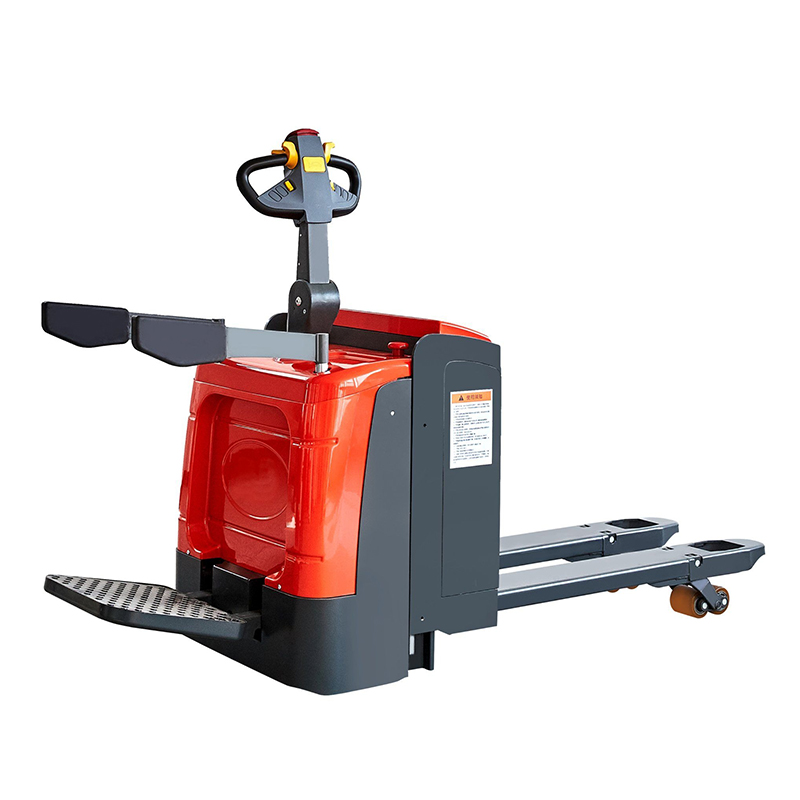
A walkie electric pallet truck features a pedestrian-operated design. The operator walks behind or beside the unit, controlling it via a tiller handle. This design offers distinct turning radius advantages. It navigates narrow aisles, retail floors, and congested staging areas where ride-on units cannot fit. The lack of a riding platform keeps the overall footprint minimal.
The optimal use case involves short-to-medium distance transport. In workflows requiring frequent stops, operator mounting and dismounting slow down the process. Walkie models eliminate this delay. Workers simply grab the handle and move. Space constraints demand maximum maneuverability, making the walkie configuration ideal for dense storage facilities and localized sorting tasks.
The tiller handle houses all controls: forward, reverse, lift, lower, and the horn. A belly-button reversing switch sits at the end of the handle. If this switch hits the operator's body, the truck instantly reverses direction, preventing crush injuries in tight spaces. The braking system engages automatically when the handle is released to the fully upright or fully lowered position.
Platform-equipped trucks serve large-scale distribution centers and cross-docking facilities. These models feature a fold-down platform and side restraints. Operators stand on the truck during transit. This configuration transforms the equipment into a high-speed transport vehicle suitable for covering several miles per shift.
The ergonomic and speed benefits are substantial. Operators avoid the fatigue of walking long distances on concrete floors. Transit times between warehouse zones drop significantly. Ride-on models often feature higher top speeds than walkie units. They are the preferred choice when moving pallets from receiving docks to distant reserve storage racks.
When navigating tight areas, the operator can fold the platform up and operate the unit as a standard walkie. This dual functionality provides flexibility for varying tasks throughout the shift. The side restraints protect the operator from impacts and provide stability during high-speed cornering.
Torque requirements dictate power system selection. Moving maximum-capacity loads from a dead stop requires significant energy. Navigating ramp inclines without motor strain demands high voltage. Standard 24V systems handle flat surfaces and moderate loads well. Heavy-duty applications push 24V systems to their thermal limits. When a 24V motor works hard, it draws high amperage, which generates heat.
A 48V electric pallet jack improves sustained performance. The higher voltage draws less current to produce the same power. This reduces heat generation in the electrical system and motors. Cooler components last longer and fail less frequently. The 48V system optimizes battery efficiency during continuous heavy use, preventing voltage drops that cause sluggish performance near the end of a shift.
Operators notice the difference on inclines. A 48V unit maintains its travel speed up a ramp, whereas a 24V unit will noticeably slow down under a heavy load. This sustained power prevents the drive motor from stalling on steep dock plates, ensuring continuous material flow during heavy loading operations.
Traction and directional control vary significantly based on the drive mechanism. Single-motor units drive one wheel, which can slip on uneven surfaces, steep dock levelers, or wet floors. When the drive wheel loses traction, the truck stops moving, and the wheel spins, damaging the polyurethane tire.
A dual-motor electric pallet truck powers two wheels independently. This provides superior grip and prevents the truck from fishtailing under heavy loads on inclines. Dual motors act like a differential. They adjust wheel speed during turns, preventing tire scrub and ensuring smooth cornering.
Maintenance trade-offs exist. Dual-motor systems introduce increased complexity. They have more moving parts, which can lead to higher potential repair costs. You have two drive motors, two gearboxes, and more complex wiring. However, this complexity yields superior operational reliability in harsh environments. When traction dictates safety and throughput, the operational benefits of dual motors outweigh the maintenance considerations.
Setting realistic runtime expectations prevents workflow interruptions. Standard 12V or 24V lead-acid setups often yield 3-4 hours of continuous heavy use. High-capacity configurations are designed for full 8-hour shifts. Lithium-ion batteries maintain a flat voltage curve, delivering consistent power until depleted. Lead-acid batteries experience voltage sag, resulting in slower operation as the charge drops.
Lithium-ion batteries offer opportunity charging capabilities. Operators can plug the truck in during breaks or shift changes. This sustains multi-shift operations without the downtime of battery swapping. A 30-minute charge during lunch can add hours of runtime.
Lead-acid batteries require strict infrastructure. Facilities must build dedicated charging rooms with ventilation for off-gassing hydrogen. They demand strict watering schedules. Maintenance staff must check water levels weekly and top off cells with distilled water. If the water level drops below the lead plates, the battery sustains permanent damage. Lead-acid batteries also require weekly equalization charges to balance cell voltages and prevent premature degradation.
Specification Feature | Standard 24V Single-Motor (Lead-Acid) | Heavy-Duty 48V Dual-Motor (Lithium-Ion) |
|---|---|---|
Incline Performance | Struggles on steep dock plates; potential wheel slip. | Maintains speed on ramps; excellent traction. |
Continuous Runtime | 3 to 4 hours under heavy load. | Full 8-hour shift with opportunity charging. |
Maintenance Needs | High (battery watering, motor brush checks). | Low (sealed batteries, brushless AC motors). |
Heat Generation | High during continuous heavy lifting. | Low due to efficient high-voltage power draw. |
Best Use Case | Light retail, flat warehouse floors, single shift. | Intensive logistics, heavy ramps, multi-shift. |
Calculating return on investment requires looking beyond the initial purchase price. Facilities must evaluate throughput increases and faster cycle times. Motorized jacks move pallets faster than manual units. This speed allows the same number of workers to process more freight per shift. Labor reallocation becomes possible, moving personnel from transport duties to higher-value tasks like picking and packing.
Manual pallet jacks carry hidden costs. Slower operations lead to lower per-shift productivity. Manual pulling causes higher rates of musculoskeletal workplace injuries. These injuries result in lost time, medical expenses, and workflow disruptions. Motorized equipment eliminates the physical strain, directly reducing these hidden operational costs. When a worker is out on medical leave due to a back injury, the facility loses productivity and incurs overtime costs to cover the shift.
Motorized lifting and driving directly mitigate the physical strain of moving heavy loads. Pushing a 3,000-pound pallet from a standstill places immense stress on the lower back, knees, and shoulders. The initial push requires the most force. Powered drive units require zero pushing effort. The operator simply engages the throttle.
This ergonomic improvement leads to fewer worker compensation claims. Employees experience less fatigue and pain. Morale improves, which translates to lower employee turnover. Retaining experienced warehouse staff reduces training costs and maintains high operational efficiency. Warehouse work is physically demanding. Providing motorized equipment shows a commitment to worker safety and extends the physical longevity of the workforce.
Understanding maintenance realities ensures maximum uptime. High-wear components require regular inspection. Load wheels, drive tires, contactors, and wiring harnesses degrade over time. Preventative maintenance intervals must be strictly followed. Replacing a worn polyurethane drive tire prevents motor strain and restores traction. If a drive tire wears down to the metal hub, it will destroy the warehouse floor and damage the drive motor gearbox.
Operating environments heavily influence equipment lifespan. Cold storage applications cause condensation that damages standard electronics. Moving from a -10°F freezer to a 70°F loading dock creates rapid condensation. Corrosive chemical exposure or salt environments degrade mild steel rapidly. These harsh conditions necessitate specialized truck configurations. Galvanized chassis, sealed bearings, and cold-storage conditioning protect the equipment and extend its functional lifespan.
To maintain peak performance, implement this routine inspection schedule:
Inspect polyurethane load wheels for flat spots, chunking, or embedded debris daily.
Check the drive tire tread depth and look for uneven wear patterns.
Test the belly-button reversing switch and emergency disconnect button before every shift.
Examine the hydraulic lift cylinder for fluid leaks or weeping seals.
Verify that the tiller handle auto-brake engages smoothly when released.
Clean battery terminals and check for corrosion or loose cable connections weekly.
Deploying heavy electric trucks on compromised floors introduces significant risk. Floor weight capacities must be verified, especially on mezzanines or older dock plates. A motorized jack with a battery and a full load can weigh over 5,000 pounds. This weight is concentrated on small polyurethane wheels, creating high point-loading.
Concrete PSI ratings matter. If the concrete is old or rated below 3,000 PSI, the continuous traffic of heavy electric trucks will cause the surface to spall and crack. Potholes, wide expansion joints, and floor debris severely impact these wheels. Hitting a pothole at speed can shatter a load wheel or bend the lifting linkage. Facilities must repair concrete spalling and fill wide expansion joints with epoxy before deploying motorized fleets.
Electrical grid capacity requires evaluation before installing multi-unit charging stations. Fast-charging lithium-ion fleets draw substantial amperage. Older facilities may lack the necessary electrical panels to support simultaneous charging of a dozen trucks. Upgrading facility wiring may be required to prevent tripped breakers and ensure all units reach full charge between shifts.
Powered industrial trucks require specific operator certification and training. Unlike manual jacks, which anyone can grab and use, motorized units fall under strict OSHA compliance requirements. Facilities must implement formal training programs covering safe operation, load handling, and daily inspection protocols. Operators must pass a written test and a practical driving evaluation.
High-speed collision risks increase in pedestrian-heavy zones. Motorized units are heavy and cannot stop instantly. Mitigation strategies are essential. Facilities should utilize programmable speed limits to restrict travel speed in congested areas. Maintenance technicians can program the truck controller to cap the top speed. Anti-rollback features on inclines prevent the truck from rolling backward when the throttle is released. Collision-avoidance sensors and blue safety lights alert pedestrians to approaching equipment.
To ensure a successful deployment and maximize operational efficiency, follow these next steps:
Conduct a comprehensive facility audit, measuring aisle widths and inspecting floor conditions for damage.
Evaluate your electrical grid capacity to ensure it can handle the required charging infrastructure.
Request OEM demo units to test in your specific environment under real load conditions.
Gather direct operator feedback on ergonomics and control layouts before committing to a fleet purchase.
A: A manual pallet truck requires physical pumping to lift the load and manual pushing or pulling to move it. An electric pallet truck uses battery-powered motors to automate both the lifting mechanism and horizontal driving, eliminating physical strain and increasing transport speed.
A: Yes. Occupational safety organizations, such as OSHA, classify motorized pallet jacks as powered industrial trucks. Operators must complete formal training, pass a knowledge evaluation, and demonstrate practical competency before being certified to operate the equipment in a facility.
A: Standard 24V lead-acid batteries typically provide 3 to 4 hours of continuous heavy use. Advanced lithium-ion setups or high-capacity 48V systems can last a full 8-hour shift. Lithium-ion batteries also allow for opportunity charging during breaks to extend runtime indefinitely.
A: Standard models are designed exclusively for smooth, flat concrete floors indoors. Their small polyurethane wheels will sink into gravel and sustain damage on rough asphalt. Specialized rough-terrain electric pallet jacks with large pneumatic tires are required for outdoor or uneven surface operations.
A: While capacities vary by manufacturer, a heavy-duty 48V electric pallet jack typically handles loads ranging from 4,000 to 8,000 pounds. The 48V system provides the necessary torque to move these maximum capacities from a dead stop and up inclines smoothly.
A: A dual-motor setup drives two wheels independently, providing superior traction and directional stability. This is crucial for navigating steep dock levelers, wet floors, or uneven surfaces where a single-motor wheel might slip, lose grip, or cause the truck to fishtail under heavy loads.


